
Cart Narcs & Classroom Norms: What We Owe Each Other (and Ourselves)
I’ve been a fan of Cart Narcs for a long time. Staged or not, their videos are a mix of comedy, sociology, and chaos. It’s like parking lot theater that reveals more about human nature than most textbooks ever could. I watch them endlessly, curious (but no longer surprised) about the behavior of people when confronted with something as simple as returning a shopping cart. You can watch an example video HERE.
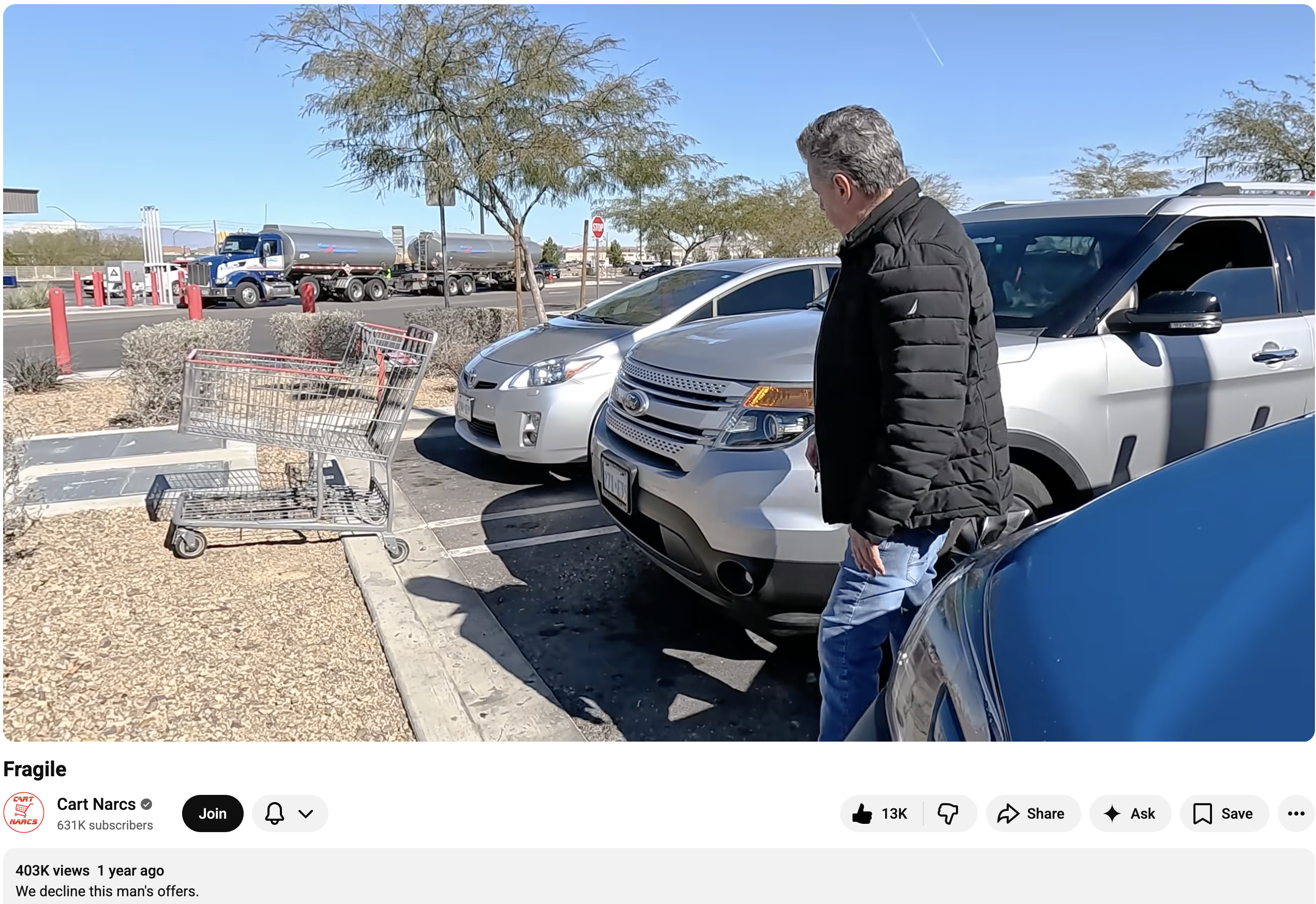
Over time, I’ve come to see these clips not just as entertainment but as case studies in everyday psychology. Recently I stumbled across an article by Hannah B. Waldfogel that broke down cart abandoners’ observable behaviors into categories like deflection, anger, excuses, entitlement, norms, etc. Reading it, I felt a loud resonance. It was like someone had taken the raw footage of Cart Narcs and translated it into a behavioral map.
And I couldn’t help myself: I immediately started drawing a parallel – comparing those behaviors to what I see in schools. And quite frankly? The parallels are too striking to ignore. I’ll let you be the judge:
1. Deflection & Authority Challenges
-
Cart Narcs: “Do you work here? Who are you? Why don’t you get a real job?”
-
Classroom: “Why do we have to do this assignment? Who even cares? You’re not the boss of me.”
-
Parallel: Both groups dodge responsibility by questioning authority instead of addressing the task at hand.
- Discussion Question: What’s really behind the pushback… are we resisting the task, or the person asking us to do it?
2. Anger & Aggression
-
Cart Narcs: Threats, yelling, even brandishing weapons.
-
Classroom: Outbursts, disrespect, or disruptive behavior when asked to follow rules.
-
Parallel: Accountability often sparks resistance, escalating when people feel cornered.
- Discussion Question: Why does being held accountable feel like an attack and how can we respond without escalating?
3. Excuses & Justifications
-
Cart Narcs: “I’m too old,” “I’m late,” “Everyone else leaves theirs.”
-
Classroom: “I didn’t have time,” “I don’t get it,” “No one else did the homework.”
-
Parallel: Excuses shift responsibility away from the individual, pointing to external factors.
- Discussion Question: What’s the difference between a reason and an excuse and how do we know which one we’re using?
4. Entitlement & Identity
-
Cart Narcs: “I worked retail for 40 years, I’ve earned this.”
-
Classroom: “I’m a senior, I shouldn’t have to do this,” or “I’m dual-enrollment, you can’t make me.”
-
Parallel: Identity becomes a shield against expectations.
- Discussion Question: When does identity empower us and when does it become a permission slip to opt out?
5. Norms & Peer Influence
-
Cart Narcs: “Everyone else just leaves them on the curb.”
-
Classroom: “No one else is paying attention, why should I?”
-
Parallel: Behavior is shaped by what peers are doing, not by what’s right.
- Discussion Question: If everyone else is doing the wrong thing, what makes it harder to do the right one?
6. Ignorance or Habitual Good Behavior
-
Cart Narcs: “I usually return it, just not this time.”
-
Classroom: “I usually do my homework, but not today.”
-
Parallel: Past compliance is used to excuse present neglect.
- Discussion Question: Does one good habit excuse a bad moment or does every choice and every moment count?
7. Compliance (Reluctant or Genuine)
-
Cart Narcs: Some eventually return carts, grumbling or apologizing.
-
Classroom: Some eventually complete tasks, reluctantly or with acknowledgment.
-
Parallel: Accountability works, sometimes grudgingly, sometimes with growth.
- Discussion Question: What shifts someone from reluctant compliance to genuine ownership and how can we support that shift?
A Pause for the Apology:
In both the parking lot and the classroom, there often isn’t a clear person to apologize to. No one’s waiting at the cart corral with a clipboard. No teacher is personally offended by a missing assignment. And yet, the moment still calls for something from us. It’s not an apology, but an adjustment. These situations aren’t about repairing a relationship; they’re about recognizing a responsibility. When there’s no direct recipient for “I’m sorry,” what’s left is the simple choice to do better next time.
Not because someone demands it, but because it’s the right thing to do.
The Crucial Observation
Here’s the part that matters most: our kids are watching.
I know shopping cart behavior may not be life-changing in the grand scheme of things, but it’s deeply instructive. When we shop, our children are with us. Sometimes they are sitting in the car, sometimes walking beside us. They see whether we return the cart or leave it adrift. We don’t tell them how to behave; we show them. Over, and over and over again…
And showing is infinitely more powerful.
The same is true in schools. Students learn far more from what adults model than from what adults say. Responsibility and respect aren’t taught through lectures; they’re absorbed through observation. The cart in the parking lot and the assignment in the classroom are both small acts, but they carry outsized meaning because they reveal how we see ourselves in relation to others.
The Bigger Picture
Neither shopping carts nor classroom assignments are the real issue. The cart isn’t about the cart. The homework isn’t about the homework. Both are about responsibility and respect.
Returning a cart shows you’re willing to take care of something small because it makes life easier for the next person. Completing an assignment shows you’re willing to follow through on expectations because it matters to your growth. In both cases, the act itself is minor, but the message it sends is major: I’m accountable, even when no one is watching.
Call to Action (yes, of course you saw this coming).
But no, I’m not just telling everyone to put their cart away.
Next time you’re with your students, ask them about their own cart behavior. Do they return it? Do they leave it? The topic is certain to illicit many responses. Perhaps my “silly” shopping cart analogy can be a reminder that responsibility shows up in the smallest choices and those choices say a lot about who we are becoming. See where the conversation takes you.
A big shout-out to Cart Narcs, whose videos over the years have made me a better parking log citizen.
🛒
🔗 Related Resources
Why Don’t People Return Their Shopping Carts? A (Somewhat) Scientific Investigation
Videos promoting personal responsibility from the courageous agents of the Cart Narcs.










That’s Suzy- Accountability, responsibility, and respect are all power of the same mix…
When folks bristle at being held accountable it seems that there is probably a lack of trust in the relationship.
And that’s to be expected when a stranger approaches you, even with respect, in a parking lot. But in a classroom or school building that trusted relationship has to be cultivated by the “authority.”
I think a great example is a sports team, where there’s a single well articulated goal that everyone buys into. We want to win. Everything a coach does is about getting to that goal.
And we’ve seen in those situations how a coach might use all sorts of tactics that do not seem respectful in order to coach players along.
So I guess the next question would be how do we build those trusted relationships every classroom?