
21. Technology Partner Solutions
LiveSelect and govern partners through requirements, contracts, implementation, measures, renewal, and exit.
Learning objectives
- Apply a partner scorecard to capability, accountability, educational fit, privacy, resilience, total cost, and exit.
- Use framework evidence and district context to explain a defensible priority or tradeoff.
- Complete the top-five vendor review, contract and privacy actions, scorecard, implementation owner, measures, and exit condition.
Instructional cycle
Frame the decision → assess current practice → learn from the framework → practice → update the 90-day plan → brief leadership → reassess.
Applied practice: Partner Accountability Check
Identify statements that hide district risk.
Topics in this Lesson
What you will be able to do
- Apply a partner scorecard to capability, accountability, educational fit, privacy, resilience, total cost, and exit.
- Use framework evidence and district context to explain a defensible priority or tradeoff.
- Complete the top-five vendor review, contract and privacy actions, scorecard, implementation owner, measures, and exit condition.
Opening dilemma
A free tool handles student metadata, but breach responsibility and data return are unclear. What evidence is required before adoption?
Commit to a response before reading. Record the assumptions behind your choice.
Pre-assessment
Before reading, rate the district’s current practice for this criterion: Partners add capability while district accountability, data control, measures, and exit remain visible.
- Emerging — informal, reactive, or dependent on one person
- Developing — partly documented or inconsistently applied
- Operational — assigned, repeatable, implemented, and evidenced
- Leading — measured, rehearsed, integrated, and continuously improved
While building a robust cybersecurity program requires comprehensive
approaches, strategic technology partnerships can significantly enhance
a district’s security posture. The feedback from districts across the
country reveals that successful cybersecurity implementation requires
more than just technical solutions. It demands creative approaches that
work within existing resource constraints.
“The biggest challenge is finding vendors who understand that our
primary mission is education, not IT security,” notes Caroline
Lightfoot, Director of Technology at Dickinson ISD. “We need partners
who can help us balance security requirements with educational needs
while working within our budget constraints.”
The right technology partners extend limited internal capabilities
with specialized expertise, allowing districts to achieve
enterprise-level protection at education-friendly pricing.
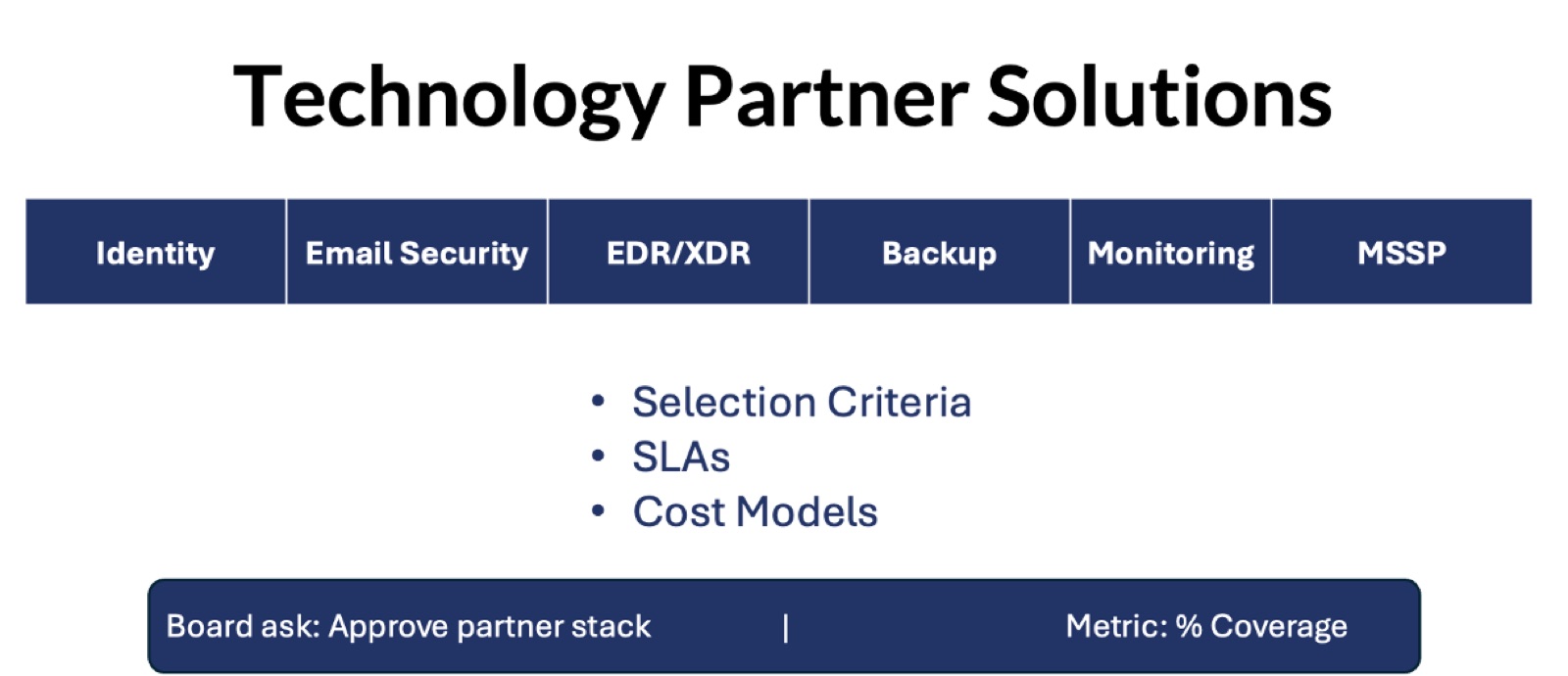
Figure: Partner stack columns (Identity, Email Security, EDR/XDR,
Backup, Monitoring, MSSP); OCR may miss “Identity,” consider darkening
that header if needed.
Rubric Checkpoint
NIST CSF Function: Multiple (GOVERN primary; see
table)
Rubric Domain: Cybersecurity Supply Chain Risk
Management
NIST CSF 2.0 Categories:
| Category | Code | Outcome |
|---|---|---|
| Cybersecurity Supply Chain Risk Management | GV.SC | Technology partners assessed and managed for risk |
| Risk Management Strategy | GV.RM | Partner selection aligned with security roadmap |
| Improvement | ID.IM | Partner capabilities extend district security maturity |
Partners extend your capabilities. The Rubric evaluates how you
select, assess, and manage security technology partnerships.
Key Maturity Indicators:
- Level 2: Vendors selected primarily on cost/features
- Level 3: Security criteria in vendor selection process
- Level 4: Formal partner assessment; ongoing monitoring
- Level 5: Strategic partnerships aligned with security roadmap
Assessment Tip: The Rubric treats security vendors
the same as EdTech vendors. “They’re a security company” isn’t
sufficient due diligence. Formal assessment demonstrates Level 3+.
Categories of Technology
Partners
Managed Security
Service Providers (MSSPs)
For districts without 24/7 security staff, MSSPs provide continuous
monitoring and response. The biggest challenge for many districts isn’t
implementing security tools. It’s having enough staff to monitor and
respond to threats around the clock.
Core Services:
- Security operations center (SOC) monitoring
- Threat detection and response
- Incident handling support
- Compliance monitoring and reporting
- Security log analysis
Key Benefits:
- Enterprise-level security expertise without full-time security
staff - 24/7 monitoring coverage with limited internal resources
- Rapid incident response with experienced analysts
- Compliance documentation and audit support
Selection Considerations:
- K-12 experience and understanding of educational environments
- Pricing models appropriate for district budgets
- Response time guarantees and escalation procedures
- Integration with existing security tools
Network Visibility Tools
Network visibility tools help districts understand and secure their
networks at the edge where traditional monitoring may miss activity.
Dan Klimke of NetAlly describes the capability: “The network tech can
walk a building or the parking lot and quickly characterize what is
going on and if there are issues, then find them fast.”
Key Capabilities:
- Comprehensive visibility into network infrastructure
- Unauthorized device and misconfiguration detection
- Wireless environment assessment
- Simplified troubleshooting for understaffed districts
- Edge security monitoring and vulnerability scanning
K-12 Relevance: With K-12’s heavy reliance on
wireless connectivity, network visibility tools help ensure secure,
reliable connections while detecting potential interference or
unauthorized access points. Edge monitoring is particularly important
for schools with numerous entry points to their networks.
Compliance Automation
Platforms
Educational institutions face a complex web of compliance
requirements. Compliance automation platforms help districts navigate
this complexity.
Dana Castine notes: “Cymetric is a lifesaver in our department. It
streamlines compliance and cybersecurity management, automating tasks
like risk assessments, documentation, and reporting.”
Core Functions:
- Automated risk assessments
- Vendor risk management
- Policy documentation and management
- Real-time compliance monitoring
- Audit preparation and reporting
Value Proposition: These tools are particularly
valuable for districts that must demonstrate compliance to various
stakeholders, including school boards, state education departments, and
funding agencies. By automating routine compliance tasks, these
platforms free IT staff to focus on more strategic security
initiatives.
Identity Management
Solutions
As educational technology becomes more integrated into daily
learning, managing user identities across multiple systems becomes
increasingly complex.
Core Capabilities:
- Single sign-on across educational systems
- Multi-factor authentication
- Role-based access control
- User lifecycle management
- Integration with Student Information Systems
Educational Focus: Identity solutions designed for
K-12 understand that security measures that impede learning are
counterproductive. They balance security with usability, ensuring
students and teachers can access needed resources while maintaining
appropriate controls.
Vendor Risk Management Tools
Modern K-12 districts rely on dozens of technology vendors. Each
vendor represents a potential security risk, making vendor risk
management critical.
Key Functions:
- Vendor security posture assessment
- Ongoing compliance monitoring
- DPA (Data Privacy Agreement) management
- Risk scoring and prioritization
- Remediation tracking
Integration Value: These tools help districts make
informed decisions about vendor selection and ensure ongoing compliance
with security requirements across the vendor ecosystem.
Security Awareness
Training Platforms
Technology solutions can only go so far. The human element remains
the most critical factor in cybersecurity success.
Training Capabilities:
- Role-specific training for staff
- Age-appropriate digital citizenship for students
- Phishing simulation and testing
- Compliance training and certification
- Engagement tracking and reporting
Cultural Impact: These platforms help districts
build security-conscious culture by making cybersecurity education
engaging and relevant to different user groups.
Voices from the Field
Caroline Lightfoot, Director of Technology, Dickinson
ISD
“Strategic vendor partnerships have been essential for our
cybersecurity success. Our technology reseller has helped us navigate
complex technology decisions and implement solutions that work
effectively in our educational environment. The key is finding partners
who understand that our primary mission is education, not IT
security.”
Dana Castine, Technology Director, Florida Union Free School
District
“Change is incredibly difficult for everyone and when it involves
technology, it becomes even more difficult. We’ve found that partnering
with technology providers who understand the educational environment
makes a huge difference. They need to understand that our primary
mission is education, not IT security.”
Mark Parsons, Director of Technology, Inter-Lakes School
District
“Working with the right technology reseller has made a huge
difference in our cybersecurity program. They’ve helped us select
solutions that provide robust security while working within our budget
constraints. The ongoing support and guidance have been invaluable for
our small team.”
Dan Klimke, Product Manager, NetAlly
“Edge network visibility fills gaps that other tools miss. The
network tech can walk a building or the parking lot and quickly
characterize what is going on and if there are issues, then find them
fast. That kind of real-time visibility is crucial for understaffed K-12
IT teams.”
Strategic Partnership
Considerations
Educational Focus
Partners should understand the unique challenges of K-12
environments:
- Student-first culture and educational priorities
- Limited resources and staff constraints
- Regulatory requirements (FERPA, COPPA, CIPA)
- Academic calendar impacts on implementation
- Balance between security and educational access
Scalability
Solutions should grow with district needs:
- Pricing that scales with student count
- Features that adapt to changing requirements
- Support for multi-building deployments
- Integration with growth in educational technology
Integration Capabilities
Tools should work seamlessly with existing infrastructure:
- Integration with Student Information Systems
- Compatibility with Learning Management Systems
- Support for existing authentication systems
- API availability for custom integrations
Compliance Support
Partners should help districts meet regulatory requirements:
- FERPA compliance documentation
- COPPA age-appropriate controls
- CIPA filtering requirements
- State-specific regulation support
- Audit preparation assistance
Training and Support
Providers should ensure successful implementation:
- Comprehensive training programs
- Ongoing support availability
- Documentation and resources
- User community and peer support
- Regular updates and improvements
Cost-Effectiveness
Solutions should fit K-12 budget constraints:
- Educational pricing programs
- Transparent pricing models
- Total cost of ownership clarity
- ROI documentation support
- Flexible payment options
Building Effective
Partnerships
Selection Process
1. Needs Assessment:
- Identify specific capability gaps
- Document requirements and priorities
- Engage stakeholders in requirements gathering
- Define success criteria
2. Vendor Research:
- Identify potential partners
- Review K-12 experience and references
- Evaluate pricing and terms
- Assess integration capabilities
3. Evaluation:
- Request demonstrations and trials
- Check references from similar districts
- Assess vendor stability and commitment
- Review contract terms and conditions
4. Pilot Implementation:
- Start with limited deployment
- Test integration with existing systems
- Gather feedback from users
- Validate ROI assumptions
5. Full Deployment:
- Plan phased rollout
- Provide comprehensive training
- Establish support procedures
- Monitor and measure effectiveness
Relationship Management
Communication:
- Regular check-ins with vendor contacts
- Clear escalation paths for issues
- Feedback mechanisms for improvement
- Strategic planning discussions
Performance Monitoring:
- Track service level agreement compliance
- Monitor system performance and availability
- Measure user satisfaction
- Assess security effectiveness
Contract Management:
- Regular contract reviews
- Renewal planning and negotiation
- Service adjustments as needed
- Exit planning for vendor transitions
Implementation Strategies
Start Small
Begin with pilot programs or limited deployments to test
effectiveness:
- Reduce risk of large-scale failures
- Build confidence among stakeholders
- Identify integration issues early
- Demonstrate value before full investment
Align with Existing
Initiatives
Integrate new tools with current technology plans:
- Leverage existing infrastructure investments
- Support broader district technology goals
- Minimize disruption to educational operations
- Build on existing staff knowledge
Provide Adequate Training
Ensure staff receive proper training on new tools:
- Include training in implementation planning
- Provide ongoing learning opportunities
- Support different learning styles
- Measure training effectiveness
Monitor and Measure
Track partnership effectiveness through metrics:
- Security incident rates and response times
- Staff satisfaction with tools and support
- Compliance posture improvements
- Cost-effectiveness analysis
Maintain Flexibility
Choose solutions that can adapt:
- Avoid long-term lock-in where possible
- Plan for vendor transitions
- Maintain data portability
- Stay informed about alternatives
The Path Forward
Technology partnerships can significantly enhance K-12 cybersecurity
capabilities when chosen and implemented strategically. Districts that
succeed in leveraging partnerships are those that:
- Select partners who understand the educational mission
- Ensure solutions enhance rather than hinder learning
- Build partnerships based on mutual understanding
- Maintain ongoing relationship management
- Measure and communicate partnership value
- Stay flexible as needs and technologies evolve
The key to success lies in selecting partners who understand that
education is the primary mission. The best security partners help
districts achieve protection that supports rather than hinders learning,
working within the constraints of educational environments while
delivering enterprise-level capabilities.
With the right partnerships in place, even small districts can
implement robust cybersecurity programs that protect student data,
support educational continuity, and extend limited internal resources
far beyond what would otherwise be possible.
What Your Boss Should Know
The Bottom Line: Technology partnerships require
modest additional budget but provide enterprise-level protection at
education-friendly pricing while preventing costly incidents.
Board Decisions Required:
- Choose partners who understand K-12 environments and offer
educational pricing - Balance managed services vs. internal capabilities based on
available resources - Treat partnership costs as operational expenses, not capital
investments
What Success Looks Like:
- Substantially better threat detection through specialized partner
capabilities - Significantly faster incident response
- IT staff focused on educational technology rather than security
monitoring
Why It’s Worth It: Strategic partnerships provide
security capabilities impossible to build internally—at a fraction of
the cost.
Interactive Activity
Reflect
Which critical partner relationship has the least explicit exit or accountability path?
Apply the lesson
Complete the top-five vendor review, contract and privacy actions, scorecard, implementation owner, measures, and exit condition.
Protect sensitive information. Use role titles and system categories. Do not enter student or staff records, credentials, network addresses, exploitable configurations, active incident details, or confidential vendor terms.
Interactive Activity
Build the boss brief
Present the partner decision, non-negotiable safeguards, proof of value, and exit trigger.
Use five parts: risk; learning impact; proposed action; decision or support needed; evidence of success.
Post-lesson rubric reassessment
Partners add capability while district accountability, data control, measures, and exit remain visible.
- Emerging — informal, reactive, or dependent on one person
- Developing — partly documented or inconsistently applied
- Operational — assigned, repeatable, implemented, and evidenced
- Leading — measured, rehearsed, integrated, and continuously improved
Use the same scale as the pre-assessment. Cite evidence of movement, or identify the next action if the rating did not change.