
Phased Implementation Roadmap
Live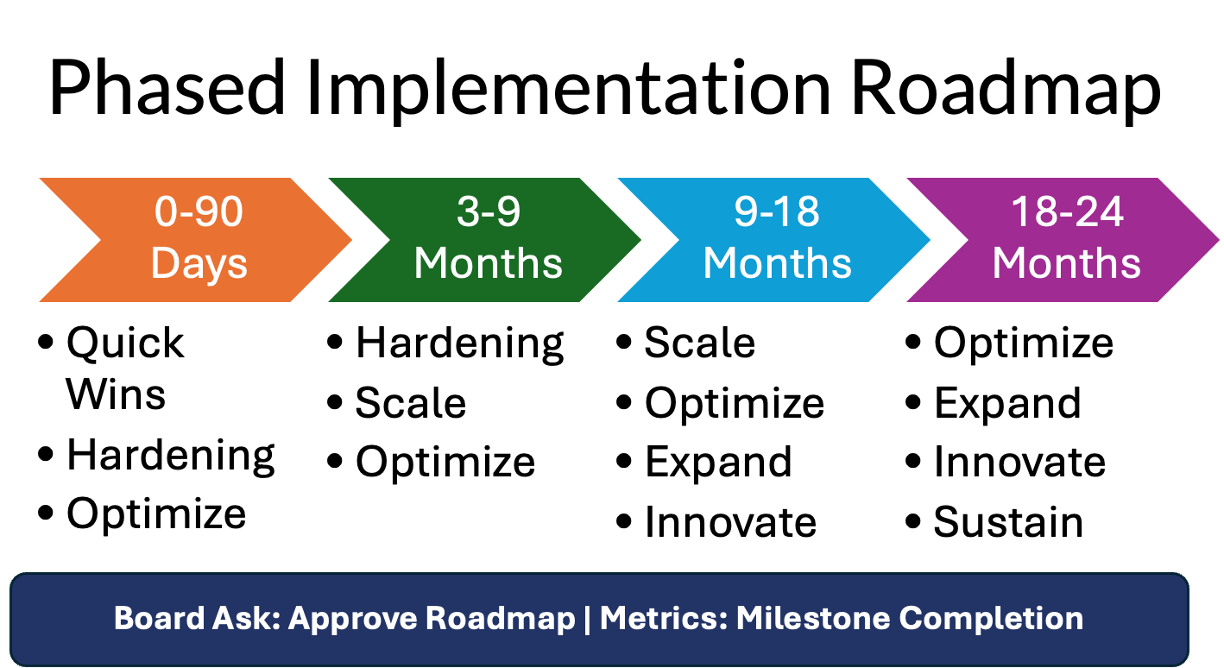
Sequence the next 24 months of security work without paralyzing the district.
Applied practice: The 30/60/90-Day Sort
Sequence cybersecurity actions by risk reduction, readiness, and instructional impact.
Topics in this Lesson
Chapter 19: Phased Implementation Roadmap
Superintendents and school boards need clear, actionable steps to transform cybersecurity from concept to reality. This roadmap provides a practical progression that balances immediate risk reduction with long-term security maturity.
“The biggest hindrance is often the sheer amount of work involved for a small team,” notes Caroline Lightfoot, Director of Technology at Dickinson ISD. “We constantly have to make sure our security measures don’t get in the way of what teachers need to do, while still keeping student data safe.”
This phased approach respects those constraints while building meaningful capability.
Framework visual: Phased Implementation Roadmap
Figure: 0–90d / 3–9m / 9–18m / 18–24m phases with milestone chips; ready for board approvals.
Rubric Checkpoint
NIST CSF Function: ALL
Rubric Domain: Improvement (across all functions)
NIST CSF 2.0 Categories:
| Category | Code | Outcome |
|---|---|---|
| Improvement | ID.IM | Security program matures through planned phases |
| Risk Management Strategy | GV.RM | Implementation priorities aligned with risk assessment |
| Oversight | GV.OV | Progress monitored and reported to leadership |
Implementation is the bridge between assessment and maturity. The Rubric measures current state; this chapter shows the path from your current level to your target level.
Key Maturity Indicators:
- Level 2: Security improvements happen opportunistically
- Level 3: Documented improvement plan with milestones
- Level 4: Phased implementation with board-approved timeline
- Level 5: Continuous improvement cycle; maturity tracking
Assessment Tip: Use your Rubric scores to identify which NIST CSF functions need the most attention, then follow the phased approach in this chapter to build toward your target maturity level.
Phase 0: Assessment and Planning (0-3 months)
Goal: Establish baseline understanding and secure leadership buy-in
Key Deliverables:
- Conduct initial security assessment
- Inventory sensitive data and critical systems
- Document current security practices
- Establish governance structure
- Secure board approval and initial funding
Estimated Costs: 10, 000−25,000 (primarily for assessment services)
Phase 1: Critical Protections (3-6 months)
Goal: Address highest-risk areas to prevent common attacks
Key Deliverables:
- MFA for all administrative accounts
- Endpoint protection across staff devices
- Automated backup systems for critical data
- Email security and basic web filtering
- Initial incident response procedures
- Basic security awareness training
Estimated Costs: 25−40 per user annually
Expected Outcomes:
- 80% reduction in successful phishing attacks
- Prevention of common malware infections
- Ability to recover from basic ransomware attempts
Phase 2: Defense Maturity (6-12 months)
Goal: Develop sustainable security operations
Key Deliverables:
- Role-based access control for major systems
- Network segmentation between critical environments
- Security log monitoring and alerting
- Data classification and handling procedures
- Vendor security assessment process
- Tabletop exercise for incident response
Estimated Costs: 50−75 per user annually
Expected Outcomes:
- Limited scope of potential breaches
- Earlier detection of incidents
- Compliance with state privacy requirements
Phase 3: Security Optimization (12-24 months)
Goal: Full integration of security into operations
Key Deliverables:
- Advanced endpoint detection and response
- Identity and access governance
- Comprehensive vendor risk management
- Vulnerability management system
- Disaster recovery capabilities
- Security metrics dashboard
Estimated Costs: 75−125 per user annually
Phase 4: Continuous Improvement (Ongoing)
Goal: Evolve capabilities with changing threats
Key Deliverables:
- Annual security assessment program
- Technology refresh with security-by-design
- Regular penetration testing
- Threat intelligence program
- Information sharing participation
Estimated Costs: 8-12% of total IT budget
The Path Forward
Implementation is the bridge between knowing what to do and actually doing it. This phased roadmap transforms the comprehensive guidance in this framework into achievable milestones that build security capability while respecting the constraints of K-12 environments.
The key to success is starting where you are and building incrementally. Phase 0 assessment creates the foundation of understanding. Each subsequent phase builds on previous gains, creating momentum that sustains the effort. Districts that follow this approach emerge with mature security capabilities that protect students and support educational mission—not through heroic effort, but through consistent, strategic progress.
What Your Boss Should Know
The Bottom Line: Phased implementation over 24 months requires meaningful additional IT budget but prevents costly incidents.
Board Decisions Required:
- Approve 24-month implementation roadmap with phased milestones
- Allocate funding across multiple fiscal years
- Dedicate staff resources to implementation coordination
What Success Looks Like:
- Phase completion within planned timelines
- Rubric score improvements at each phase milestone
- Reduced security incidents as protections mature
Why It’s Worth It: One major incident costs more than the entire 24-month implementation budget.