
3. Why Do Scripts and Stories Exist
Live
In lesson 1, “Examples of Scripts and Stories in Our Lives”, you explored how scripts and stories shape your daily responses—often without your awareness. In this lesson, you’ll go deeper: Why do these automatic patterns exist in the first place? What is their evolutionary purpose, and how can we better recognize when they serve us—and when they don’t?
Your brain is designed to help you survive, adapt, and act efficiently. Scripts and stories are tools it uses to do just that. But those same tools can sometimes block your growth, distort your perception, and even sabotage your best intentions. In this module, you’ll begin to understand the architecture behind your reactions—and how to shift from survival to resourcefulness.
We often think of stories as something we create with effort. But in truth, our brains generate them constantly—automatically, even instinctively. From childhood to adulthood, we navigate life using internal narratives: how things work, what’s safe, what to expect, who we are.
These stories are a powerful survival tool. This lesson explores how and why our brains evolved to use stories and scripts, and why they’ve become central to how we think, learn, and act.
Why It Matters
Understanding how your brain is wired helps explain why you sometimes react in ways that limit—even frustrate—you. These reactions aren’t personal failings. They’re fast survival patterns that once protected you.
We aren’t flawed for reacting with old scripts. We’re wired that way. But once we recognize that wiring, we gain the ability to use it more wisely. Instead of letting our stories run us, we can begin to choose which ones we follow.
? Introduction & Learning Goals
In this lesson, you will:
- Review the five core limbic reactions and how they drive scripts
- Understand how stories reinforce scripts and can justify reactive behavior
- Explore the survival advantage of fast responses—and the cost
- Recognize when defensive stories and stress responses override reason
- Learn strategies to calm reactivity and shift toward thoughtful action
- Learn how stories can be harnessed to improve teaching, memory, and action
- Explore the strengths and trade-offs of relying on scripts in daily life
Topics in this Lesson

The topics 3.1 and 3.2 are quick reviews of the concepts covered in Module 1. Feel free to skim this material or read closely to lock the terms and concepts in your brain.
Your brain has five core reactive patterns, managed by the limbic system. You saw these in Module 1.
Here, we take a closer look at the five limbic action types, all of which operate rapidly and automatically. These actions are governed by your brain’s limbic system, not the slower, more reflective prefrontal cortex.
Whenever you take one of those actions automatically, that’s a script. Whenever you explain or justify why you took that action—even just to yourself—that’s a story.
The Five Limbic Reactions
1. Freeze
Your first instinct may be to stop—completely. Freezing allows you to gather more information or avoid drawing attention.
Helpful: Pausing before responding in an unfamiliar situation.
Unhelpful: Going blank in a job interview despite preparation.
2. Fight
This response activates when you feel the need to defend or assert yourself. It can show up as anger, irritation, or control.
Helpful: Standing up for someone being treated unfairly.
Unhelpful: Snapping at a colleague who disagrees with you.
3. Flight
When faced with discomfort, you may want to escape—physically or emotionally.
Helpful: Leaving a dangerous or toxic situation.
Unhelpful: Avoiding important conversations due to discomfort.
4. Fluency (Habit)
When something becomes second nature, your brain doesn’t need to analyze—it just executes.
Helpful: Brushing your teeth every morning without needing to think.
Unhelpful: Checking your phone compulsively during conversations.
5. Mimicry
You mirror the behavior of others to feel safer or more accepted. This can help in new situations but may also suppress individuality.
Helpful: Adopting positive behaviors in a new team or culture.
Unhelpful: Going along with unethical actions to fit in.
Scripts are built from these reactions—patterns stored through repetition.
? Interactive Exercise: Understanding the Five Limbic Reactions
Instructions: Each question below describes a behavior or scenario. Choose the answer that best matches the type of limbic reaction being described, or the effect it has.
? Key Takeaways
- The limbic system governs fast, reactive behavior.
- These five patterns are the building blocks of scripts.
- Every reaction has helpful and unhelpful sides—context is key.

Two Systems, One Brain
Your brain has two major systems that influence how you respond to the world:
- the limbic system, which is fast, reactive, and emotionally driven
- and the prefrontal cortex (PFC), which is slower, reflective, and resourceful.
This dual structure is not a flaw—it’s an evolutionary advantage. It helps you survive in urgent situations and adapt in complex ones.
The Role of the Limbic System
The limbic system is your brain’s alarm system. It evolved to help you survive in a dangerous and unpredictable world. When something seems threatening, this system kicks in immediately—before you even consciously register what’s happening.
Its strengths:
- Speed: It reacts faster than conscious thought.
- Automation: It uses habits, instincts, and emotional memory to act quickly.
- Survival focus: It prioritizes safety over opportunity and long term values.
Without it, your ancestors wouldn’t have lived long enough to reproduce. You wouldn’t dodge oncoming traffic. You wouldn’t flinch at danger.
But the limbic system doesn’t evaluate situations logically—it reacts based on past experiences and perceived risk. And not every perceived threat is real.
The Role of the Prefrontal Cortex
The prefrontal cortex is your brain’s strategic center. It evolved later and is responsible for:
- Planning
- Emotional regulation
- Empathy
- Creativity
- Critical thinking
Unlike the limbic system, the PFC is slow and effortful. It requires energy and attention to activate. But when it is engaged, it allows you to reflect, choose, and adapt intentionally.
Why We Need Both
Together, these two systems give you a powerful toolkit:
- The limbic system keeps you safe and efficient.
- The prefrontal cortex helps you grow and make thoughtful decisions.
You can think of it this way:
- In danger or in a routine? You want speed and efficiency. (Limbic)
- In a dilemma? You want strategy. (PFC)
The challenge is knowing which system is running the show—and whether it’s the right one for the situation.
? Key Takeaways
- Your brain evolved two systems: a fast-acting limbic system and a slower, more thoughtful prefrontal cortex.
- The limbic system prioritizes safety and speed—it reacts based on perceived threats, habits, and emotional memory.
- The prefrontal cortex supports complex decision-making, creativity, and emotional regulation.
- Real growth begins when you can recognize which system is active—and shift toward the one that serves you best.
Long before we had language—or even conscious thought—our brains had one job: keep us alive.
For early humans and animals alike, that meant reacting fast. When a predator appeared, there wasn’t time to analyze. The brain needed shortcuts: Is this safe or dangerous? Can I eat it or should I run? What have I seen before that’s like this?
The limbic brain—the fast, automatic system—developed to handle these split-second decisions. It filters through massive amounts of sensory input and helps the body act without delay. Even today, your brain is constantly filtering sounds, sights, smells, and physical sensations—prioritizing only the ones most likely to matter for your survival or well-being.
Survival is about learning from what happened. That’s where stories come in.
Stories are how the brain simplifies complexity. They help us interpret what just happened—and decide what to do next time. If something worked once, the brain remembers. If something hurt us, it stores a warning. These mental shortcuts become scripts: quick instructions for what to expect and how to respond.
That efficiency is crucial. Your brain can’t afford to analyze every situation from scratch. So it builds patterns. It uses stories.
Even in modern life, this plays out every day. Imagine driving: you’re navigating the road, checking mirrors, noticing signs, listening to music, talking to a passenger, and adjusting the temperature—all without consciously thinking about most of it. Your brain filters what’s relevant and fills in the rest with patterns it already knows.
This is why stories matter. They are not just entertainment—they’re how the brain manages complexity, conserves energy, and prepares you to act.
Stories are the Brain’s Shortcut
When something new happens, your brain initially goes through a full evaluation: Is this familiar? Is it a threat? What are my options? But once that type of situation repeats—just once or twice—your brain stores a shortcut: a story and script that tells you how to respond.
The next time it happens, those steps get bypassed. You don’t evaluate; you react. That’s how mental shortcuts form, and how stories become scripts that drive behavior automatically.
One of the most powerful of these shortcuts is the use of internal stories. Rather than starting from zero each time, your brain pulls from what it already knows—previous experiences, associations, and emotional memories—and wraps them into a narrative. That narrative tells you not just what’s going on, but what to expect and how to act.
You don’t pause at a stop sign to calculate whether to slow down. You respond instantly, because the meaning of that symbol is part of a stored story. Your reaction isn’t random—it’s scripted.
The same applies socially and emotionally:
- A raised eyebrow might trigger a story about disapproval.
- A late reply might feel like rejection.
- A compliment might be interpreted as sarcasm.
In each case, your brain saves effort by using a story instead of re-evaluating the situation from scratch.
Stories Serve Speed—Not Always Accuracy
These internal stories serve a vital function: they help us respond quickly, often within fractions of a second. That speed can be life-saving in dangerous situations—or simply convenient in daily routines.
But fast is not the same as thoughtful. The brain’s reliance on pre-existing stories means we don’t always question whether a story fits the current moment. We act based on what feels true—because it’s familiar.
That’s the evolutionary trade-off: efficiency over precision.

This diagram shows the two ways your brain can respond to a situation:
- The top path is slower and effortful. It moves through analysis—identifying patterns, evaluating threats, weighing possible actions—before choosing how to respond. It takes more brainpower, but the response is often well-matched to the situation.
- The shortcut path is faster and automatic. Your brain jumps straight from the event to a familiar story or script, and then acts. It uses less effort—and while it’s not always precise, it’s often “good enough” for everyday situations.
This is the evolutionary trade-off: speed and efficiency versus thoughtful precision.
? Key Takeaways
- The brain creates stories to reduce cognitive workload and increase reaction speed.
- These stories are based on past experiences, emotional associations, and learned patterns.
- While they help us function efficiently, they can also distort perception if left unexamined.
- Not all stories are wrong—but they’re rarely neutral. Becoming aware of them is the first step to thinking more clearly.

When we’re young, the world is full of novelty. Each day brings new situations, challenges, and unfamiliar experiences. To navigate this, the brain works hard—it calls on the prefrontal cortex (PFC) to reflect, make sense of things, and choose how to respond. This requires focus, attention, and flexibility.
But as we get older, fewer things feel truly new. We’ve seen similar people, similar problems, similar moments. And when the brain recognizes a pattern, it shifts into a different mode—not one of exploration, but of efficiency.
Rather than engaging the PFC every time, we begin to rely more on scripts: stored ways of interpreting situations and responding to them.
Why This Becomes Automatic
As you’ve seen earlier, scripts and stories offer the brain a shortcut. When a situation feels familiar, the brain doesn’t ask:
“Is this the best response?” or “Could there be more going on here?” Instead, it retrieves a familiar pattern and acts on it—often quickly, often confidently.
This shift from conscious thinking to automatic responding is not a flaw. It’s an adaptation. It helps us conserve mental energy and respond efficiently. But over time, we may stop questioning whether those old scripts still fit new realities.
? Key Takeaways
- As we age, we accumulate more internal stories and scripts.
- This shift favors efficiency over reflection—and reduces reliance on the PFC.
- While this saves energy, it can also prevent us from adapting to new or changing situations.
The challenge is not to erase our stories, but to remain aware of when they’re running the show.
So far, you’ve seen how stories and scripts help the brain react quickly and conserve effort. But their value doesn’t end there.
Stories also play a crucial role in how we learn and remember.
Think back to the last time you truly remembered something new—not just for a test, but long afterward. Chances are, it wasn’t a list of abstract facts. It was a story.
Our brains are built for narrative. When information is placed in a sequence—when it has characters, emotion, or cause and effect—we understand it more easily. But more importantly, we remember it. That’s because stories link new information to what we already know, creating a structure that’s easier to recall.
This is why metaphors, analogies, and personal examples are such powerful teaching tools. They turn isolated details into meaningful patterns.
Why the Brain Prefers Stories
At the core of every story is meaning. It answers not just what, but why. And that matters because the brain isn’t just trying to collect facts—it’s trying to navigate the world.
When we encounter a new concept, the brain asks:
- How does this connect to what I already know?
- What should I do with this information?
- Why does it matter to me?
A well-formed story answers those questions all at once.
That’s why storytelling is effective whether you’re trying to teach a child, coach a colleague, or make sense of something yourself.
Using Stories to Teach (and Learn)
Let’s take two examples:
- Teaching someone how to deal with conflict:
Instead of listing communication tips, imagine sharing this story:
Two colleagues disagree during a team meeting. One interrupts the other and raises their voice. The second person feels disrespected and withdraws. Tension lingers for days. Later, they learn that the outburst wasn’t about the topic at all—the person had just received stressful news before the meeting. When learners hear this story, they follow the emotional arc. They recognize how unspoken assumptions and stress can shape conflict. The story teaches an important lesson: Before reacting, consider what might be going on beneath the surface. Because it’s told as a story—not just advice—the message becomes more relatable and easier to remember. - Learning a new habit yourself:
Many people resist starting a new routine—like exercising—and then criticize themselves with thoughts like “I should work out more.”
But guilt doesn’t usually help. These stories can feel heavy or self-judging, making it even harder to begin.
Instead, try a more open and affirming story:
“I’m someone who feels better and thinks more clearly when I move my body.”
That small shift changes how the brain relates to the action. It’s no longer about obligation—it’s about identity and emotional reward. And that tone makes it easier to stay consistent.
Whether you’re on the teaching or learning side, embedding new ideas in a story makes them more memorable, more personal, and more actionable.

? Interactive Exercise: Why Stories Help Us Learn
Instructions: Read each question and choose the option that best explains how and why stories support learning, memory, and personal change. This quiz will help you reflect on the power of narrative in both teaching and everyday life.
? Key Takeaways
- Stories are ideal containers for learning because they tie new ideas to emotion and memory.
- The brain prefers information that feels meaningful, connected, and actionable.
- Using stories to teach others—or yourself—can dramatically increase understanding and retention.
- A good story is not just remembered—it’s lived.
Limbic Alarm: When Familiar Patterns Are Threatened
Your brain feels safest when the world fits your internal map—your scripts and stories. But what happens when something challenges those patterns? A comment, a new piece of information, or a shift in circumstances can all feel like threats to the status quo.
When that happens, your amygdala activates.
That might happen when:
- You receive criticism on your project.
- You offer help, and someone declines.
- A friend challenges your view on something personal.
In each of these situations, your amygdala lights up because your limbic system detects a possible threat—not necessarily a real one, but a perceived disruption. In response, your limbic system initiates a fight, flight, or freeze response. This flood of stress hormones helps you react quickly but shuts down your prefrontal cortex—the part of your brain responsible for reason, reflection, and flexible thinking.
The cost? In moments when you most need your higher thinking, it’s temporarily offline.
When the Mind Becomes a Saboteur
When our reactions are counterproductive, and our internal stories justify them, our brain is not protecting us—it’s sabotaging us.
This is what we call Saboteur Mode: a state in which we instinctively reject feedback, ignore nuance, and defend ourselves at all costs.

Real-Life Examples: Limbic Reactions in Action
Let’s look at some situations where scripts and stories are challenged—and typical limbic reactions kick in:
- Feedback at work:
You receive criticism on your project. Your reaction is defensiveness. The internal story?
“They don’t see how hard I worked.”
You stop listening and miss a chance to improve. - An unexpected rejection:
You offer help, and someone declines. You feel hurt and withdraw.
Story: “They don’t want me around.”
You avoid future opportunities for connection. - A disagreement with a friend:
They challenge your view on something personal. You feel angry.
Script: You raise your voice.
Story: “They’re being disrespectful.”
The result? Distance, not understanding.
These moments often happen faster than conscious thought—and the story that follows often reinforces the reaction, even if it was misaligned.
Autopilot Reactions: Helpful and Harmful
Even without a direct challenge, your brain can slip into limbic autopilot. Two situations make this especially likely:
1. When You’re Not Really Thinking
This happens when you’ve done something so many times it becomes automatic—or when you’re simply bored.
- Helpful example:
A nurse efficiently preps a procedure thanks to practiced routines. - Harmful example:
You ignore a safety step at work because “it’s always fine”—until it isn’t.
Scripts save time, but they can also lead to oversights when you’re not fully present.
2. When You’re Around Others
We naturally mirror the people around us. It helps us learn and belong—but it also makes us susceptible to groupthink.
- Helpful example:
In a workshop, people start asking vulnerable questions. You join in, feeling supported. - Harmful example:
Everyone laughs at a joke you find offensive. You stay silent, even though it goes against your values.
Belonging is powerful. But when it overrides your internal compass, it becomes a script worth examining.
? Interactive Exercise: Recognizing Defensive Reactions in Others
Instructions: Read each scenario and choose the option that best reflects a defensive or limbic reaction. This exercise will help you spot when someone is acting from Saboteur Mode—so you can respond with more awareness and empathy.
? Key Takeaways
- When stories and scripts are challenged, your limbic system may react with stress, shutting down reflection.
- These fast reactions feel justified—but often reinforce unhelpful patterns.
- Your brain goes into “saboteur mode” when it defends a story at the cost of growth.
- Autopilot behavior can be helpful or harmful—especially when we’re not thinking or when group pressure is strong.
- Awareness helps you pause, question the story, and choose a different response.
How Do We Escape Saboteur Mode?
You’ve now seen how scripts and stories shape our behavior—often outside of awareness—and how they can become defensive, rigid, or reactive when challenged. The good news is: your brain can change.
There are two complementary ways to improve your ability to respond with intention rather than reaction.
1. Develop Better Scripts Through Practice
Your limbic system isn’t going away—and that’s a good thing. It’s what allows you to respond quickly in daily life. But you can train it to react more constructively.
By developing new habits and fluencies, you expand your repertoire of automatic responses. Over time, those new responses become your new scripts—and they serve you better.
- A toddler initially struggles with walking, but becomes more proficient through practice.
- A teacher who once snapped at noisy students now uses a practiced de-escalation technique automatically.
- A manager who used to avoid hard conversations now instinctively opens with curiosity and clarity.
- A parent who once yelled now takes a practiced breath and redirects with compassion.
None of these changes happen overnight. But with repetition, what was once difficult becomes natural.
2. Interrupt the Reaction with Awareness
Sometimes, building better scripts isn’t enough. You also need tools for pausing the old ones in the moment—especially when you’re feeling triggered, overwhelmed, or stuck.
This is where recognizing your state becomes powerful.
When you feel your body tense, your emotions rise, or your thoughts narrow, those are signs that you’re in a limbic state. Your prefrontal cortex is being pushed aside. Instead of arguing with yourself or trying to “be rational,” you can try something simpler: a pattern-interrupt.
One of the most effective ones?
You’ve seen it before—in Module 1, when we explored how to shift out of “I can’t” thinking.
“Perhaps I can…”
It’s a small phrase—but it opens the door to possibility. Instead of debating the story directly, you sidestep it.
Instead of: “I can’t handle this.”
You try: “Perhaps I can” and let your prefrontal cortex create some possibilities
Instead of: “This will never work.”
You try: “What if I could? What would be the first thing I’d try?””
This subtle shift creates just enough space for your prefrontal cortex to re-engage—bringing with it curiosity, creativity, empathy, and strategic thinking.
From Survival to Resourcefulness
“Perhaps I can…” isn’t the only way to pause the limbic system and invite the prefrontal cortex (PFC) back online. Over the years, learners have discovered and shared open-ended alternatives—phrases that lower the resistance of the reactive brain and reopen the path to resourcefulness.
These variations don’t demand certainty. They invite exploration.
Try a few. Notice how each one feels in your body. These aren’t just linguistic tricks—they’re tools to shift state.
Here are some powerful examples:
“I can’t…yet.”
Voice: “I can’t do this.”
Shift: “I can’t do this…yet. But maybe with some practice, I’ll get closer.”
Why it works: Suggests progress is possible—without pretending it’s already easy.
“What if I could…?”
Voice: “I can’t do this.”
Shift: “What if I could? What would be the first thing I’d try?”
Why it works: Sparks curiosity and activates brainstorming—your PFC loves this.
“I haven’t figured it out yet.”
Voice: “I can’t solve this.”
Shift: “I haven’t figured it out yet. I’m still learning.”
Why it works: Reframes failure as part of the learning process.
“How could I…?”
Voice: “I can’t handle this.”
Shift: “How could I handle this? What would be a small step forward?”
Why it works: This question actively recruits the PFC into solution mode.
Each of these phrases opens up a little space. That space is where your resourceful self lives. You’re not forcing yourself to act. You’re giving yourself permission to look again—with clarity, calm, and creativity.
These phrases are bridges—from the part of you that reacts, to the part of you that responds.
? Interactive Exercise: Two Ways to Improve Your Responses
Instructions: Each question below explores how we move from reactive to resourceful. Choose the option that best reflects how practice or awareness can help shift your responses in challenging moments.
? Key Takeaways
- The limbic system resists direct challenges—but it responds to gentle questions and possibilities.
- Language matters. Small shifts like “perhaps I can” or “what if I could?” reduce defensiveness.
- These phrases help reactivate the prefrontal cortex by creating space and lowering perceived threat.
- Practicing and personalizing these tools makes them more accessible in the moments you need them most.
Scripts aren't the enemy – they're efficient when the situation fits and misfire when it changes. Read each moment and judge whether the script is helping or hurting.
The goal isn't to delete your scripts, it's to notice the ones that no longer fit and update the story so a better response can run.
Interactive Activity
? AI Mentor Interaction: “Good Stories and Scripts”
Goals
This conversation is designed to help you recognize when scripts and stories support your goals. While much of this module has focused on limiting or outdated patterns, many scripts and stories are efficient, adaptive, and empowering. By exploring helpful examples, you’ll deepen your ability to notice what’s working—so you can build on it intentionally.
Instructions
Think of a situation where you acted quickly and it worked well—perhaps in a routine at work, a social situation, or a moment of challenge. Share the situation with Coach Robbi, including what you did and how you interpreted the moment.
Then explore together:
- What script helped you act effectively?
- What story (conscious or not) supported your confidence or clarity?
- How might you strengthen or replicate that pattern in other areas?
You can also examine examples from people around you: someone who stays calm under pressure, acts generously, or responds wisely in conflict. The goal is to notice what’s helpful—not just what’s hard.
This is another AI Interaction, and it is going to ask you, “Are you ready to start?“. It will get confused if you answer “yes”, so instead of answering yes, just answer, “Let’s start.”
Remember that AI is not human, it often does not know when to stop asking you questions. The purpose of this exercise is to help you identify helpful scipts and internal stories. When you feel the interaction has accomplished this, click on the End Chat button.
? What You’ve Just Practiced
In this conversation, you’ve shifted focus toward your strengths. By identifying helpful scripts and constructive internal stories, you’ve learned how to reinforce patterns that align with your values and goals. Awareness doesn’t just help us change what’s broken—it also helps us build on what’s already working.
By now, you’ve explored why scripts and stories exist—not as flaws, but as survival tools your brain uses to act fast, conserve energy, and navigate uncertainty. These mental shortcuts evolved to protect you, but they don’t always serve you well today.
When your limbic system takes the lead, you might freeze, fight, flee, mimic others, or rely on habit—even when the situation doesn’t call for it. And afterward, your brain often builds a story to justify what just happened. These stories feel true because they come so quickly—but many of them are just familiar patterns, not facts.
When challenged, your fast brain can shift into saboteur mode—defending old scripts, rejecting feedback, and shutting down your thinking brain. But you now have tools to change that. By practicing new scripts and using gentle reframing strategies like “Perhaps I can…”, you’ve learned how to calm your reactive mind and bring your prefrontal cortex back online.
How Belief Shapes Behavior
The internal story you carry influences how much effort you’re willing to give, how long you persevere, and how creative you’re willing to be. Even subtle shifts in narrative—what you believe about your capacity—can change the way you approach a challenge.
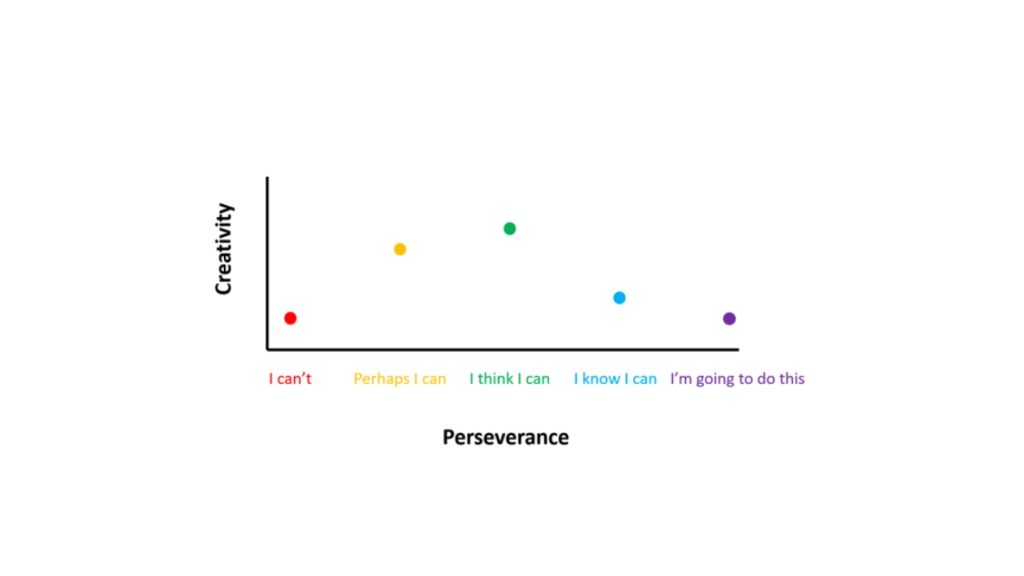
The diagram above, which you first saw in Module 1, captures this idea:
Each level represents a different kind of story:
- “I can’t” shuts you down.
- “Perhaps I can” sparks hope.
- “I think I can” builds momentum.
- “I know I can” brings confidence.
- “I’m going to do this” locks in commitment.
But as you’ve seen in Module 1 and again in Lesson 6, certainty—on either end—can close off flexibility. Whether it’s “I can’t” or “I know I can,” both are stories. And when we recognize them as such, we can choose to reopen the brain to reflection, curiosity, and new possibilities.
Wherever you find yourself on this scale, the story you tell can move you forward—or hold you back.
? Key Takeaways
- Scripts and stories are part of how your brain keeps you safe and efficient—but they can also block growth.
- The limbic system is fast and emotional; the prefrontal cortex is slower but more resourceful.
- Not every threat is real—but your brain reacts as if it is.
- Saboteur mode shuts down reflection and locks you into reactive loops.
- You can improve by both building better habits and learning to interrupt old scripts with tools like “perhaps I can…”
- When used consciously, stories can enhance learning, memory, and decision-making.
Next Steps in MindShifting
In the next lesson, you’ll explore your inner critic—the voice of Part X—and how it uses stories to keep you stuck. You’ll learn to recognize its tactics and begin building the courage to act, even when that voice is loud. For now, take a moment to notice which stories and scripts came up most for you in this lesson—and which ones you might be ready to question.
Your awareness is growing. And with it, your ability to choose.