
The Cost of Reactive Thinking in Schools: How Leaders Help School Communities Respond Instead of React
Imagine rolling out a critical new initiative—perhaps a district-wide shift to the science of reading or a new equity-based grading policy. During cabinet and staff meetings, everyone nods along. They agree to the timelines and give the initiative enthusiastic lip service. But months later, the rollout stalls.
Behind closed doors, teachers are continuing to teach the way they’ve always taught and principals are putting out so many fires that they don’t have the energy to overcome the friction of enforcing the change.
Why does this happen? It isn’t because your educators are stubbornly defiant. It is because the stress of change triggered their limbic systems. When faced with the discomfort of a new initiative, people naturally react from this survival center—defaulting to fight, flight, freeze, or simply hiding in the safety of the herd.
The Science: Why We React Instead of Respond
To lead a district through change, administrators must understand that every person operates with two basic brain modes.
- The Reactive Brain (Limbic): This mode is fast, automatic, and highly protective. It scans for threats, makes snap judgments, and reacts before the person has a chance to think. When a conversation gets tense or a new policy feels overwhelming, this limbic brain takes the wheel. Staff might get louder, go quiet, change the subject, or just agree to make the discomfort stop.
- The Thinking Brain (Sage): This mode is slower, more creative, and infinitely more curious. This is where problem-solving happens, where empathy lives, and where individuals can see a situation from multiple angles.
The biological catch is that both brains cannot work well at the same time. Once the reactive limbic brain is in charge, the resourceful thinking brain merely rationalizes the subconscious, quick, emotional decisions of the survival or limbic brain. However, humans have the unique power to realize what is happening in real-time. By shifting from a limbic state to a more resourceful state, individuals become far more resilient, perseverent, open, and curious.
Techniques for the Community: Reclaiming the Thinking Brain
School leaders can empower their staff by teaching them to recognize when their reactive brains take over. Helping your community practice three simple steps can shift an entire school’s culture:
- Notice the Signal: Teach staff to identify what their reactive brain feels like physically. Is it a tight chest, a clenched jaw, heat in the face, or a dropping stomach?
- Notice the Default: Ask staff to observe their patterns when tension rises. Do they get louder, go quiet, change the subject, or agree just to end the interaction?
- The 5-Second Pause: When staff catch themselves reacting, they should give themselves a five-second pause before responding. That tiny, five-second gap is all it takes to shift control back to the thinking brain.
Techniques for the Leader: The 6-Step MindShifting Approach
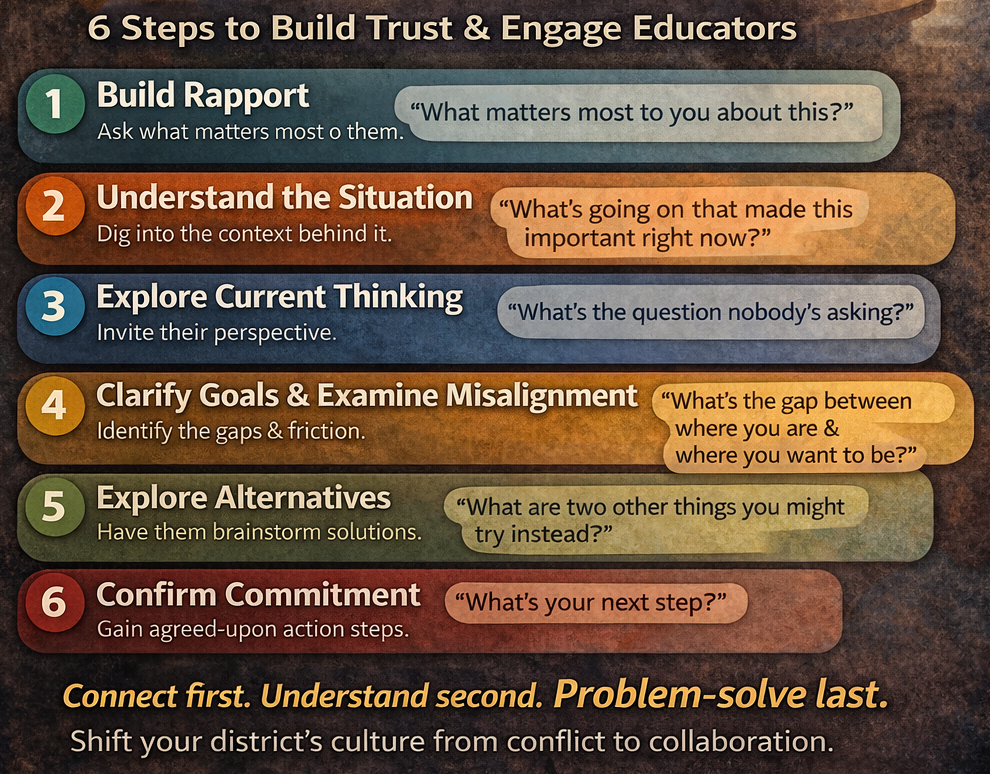
When administrators face resistance to an initiative, the natural instinct is to push harder with facts and solutions. However, skipping straight to solutions without building trust backfires every time. The core rule for leaders navigating difficult interactions is: Connect first. Understand second. Problem-solve last.
To bypass the limbic brain and activate the thinking brain in your staff, use this 6-step conversational framework:
- Build Rapport: Start by demonstrating genuine curiosity. Ask, “What matters most to you about this?”.
- Understand the Situation: Dig into the context before offering advice. Ask, “What’s going on that made this important right now?”.
- Explore Current Thinking: Invite their perspective by asking, “What’s the question nobody’s asking?”.
- Clarify Goals & Examine Misalignment: Help them see the friction between their current actions and desired outcomes. Ask, “What’s the gap between where you are and where you want to be?”.
- Explore Alternatives: Shift them into problem-solving mode by asking, “What are two other things you might try instead?”.
- Confirm Commitment: Secure actionable buy-in by asking, “What’s your next step?”.
By utilizing these steps, you stop interrogating your staff and start understanding them—shifting your district’s culture from conflict to true collaboration.
——————————————————————————–
Take the Next Step in Your District
If you want to help your staff get those first three steps going—noticing the signal, identifying the default, and taking a 5-second pause—we offer a downloadable “Why We React Instead of Respond” Conversation Circle packet. This playbook provides administrators with everything they need—from icebreakers to guided discussion questions—to safely lead staff through this transformational process.
While this article serves as an overview of these techniques, district leaders looking for a deep dive into these concepts can find the complete system in the book MindShifting: Conflict and Collaboration.
🔗 Related Resources
You don’t need a conflict‑resolution expert or a new initiative to launch. Everything is built for a non‑expert host: a playbook, icebreakers, a guided conversation arc with questions and timing, troubleshooting tips, and a closing script.
Drawing from neuroscience, psychology, motivational interviewing, nonviolent communication, and organizational research, Mitch presents a practical toolkit to turn conflict into opportunity. The central message: conflict doesn’t have to divide us; it can become a pathway to growth, stronger relationships, and shared progress.