
1. Student-First Security Culture
LiveBalance strong controls with instructional continuity, student access, privacy, and educator trust.
Learning objectives
- Evaluate a proposed control through protection, access, trust, privacy, and instructional-disruption lenses.
- Use framework evidence and district context to explain a defensible priority or tradeoff.
- Record one friction hotspot, a safe 48-hour response, and one 90-day improvement.
Instructional cycle
Frame the decision → assess current practice → learn from the framework → practice → update the 90-day plan → brief leadership → reassess.
Applied practice: The Substitute Teacher Dilemma
Choose the accountable, low-disruption access path.
Topics in this Lesson
What you will be able to do
- Evaluate a proposed control through protection, access, trust, privacy, and instructional-disruption lenses.
- Use framework evidence and district context to explain a defensible priority or tradeoff.
- Record one friction hotspot, a safe 48-hour response, and one 90-day improvement.
Opening dilemma
A substitute needs immediate access to a lesson plan, but the normal identity workflow is unavailable. What exception protects both instruction and accountability?
Commit to a response before reading. Record the assumptions behind your choice.
Pre-assessment
Before reading, rate the district’s current practice for this criterion: Student-first controls are designed with educators, tested against school-day realities, and adjusted with evidence.
- Emerging — informal, reactive, or dependent on one person
- Developing — partly documented or inconsistently applied
- Operational — assigned, repeatable, implemented, and evidenced
- Leading — measured, rehearsed, integrated, and continuously improved
K-12 cybersecurity exists in a unique environment where every
security decision must balance protection with learning. Unlike
corporate environments where security can be the primary concern,
schools must prioritize student access, teacher flexibility, and
instructional continuity. This creates a constant tension that
cybersecurity professionals in other sectors rarely face.
When Dickinson ISD Director of Technology Caroline Lightfoot
describes her district’s approach to password resets, she captures this
tension perfectly: “We know it’s a best practice to reset passwords
regularly to improve security. However, because of the ‘students first’
approach, we’re not actually doing forced password resets for students
in Pre-Kindergarten through 5th grade. The concern is that it would
create too much disruption for our youngest learners and their
teachers.”
This student-first mindset creates cybersecurity challenges that
require creative solutions and constant balancing. The question becomes:
How do you maintain robust security while ensuring that learning never
stops?
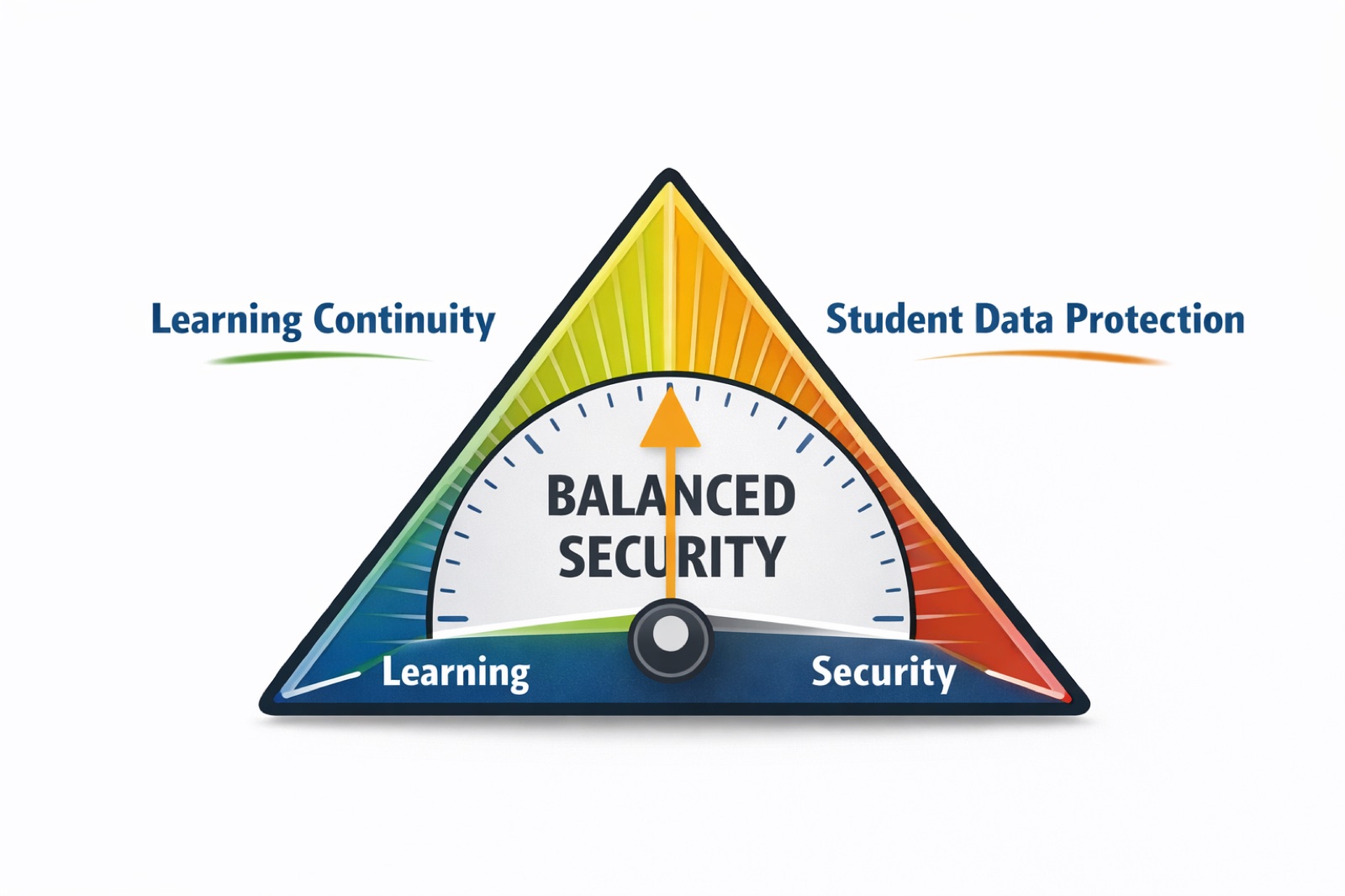
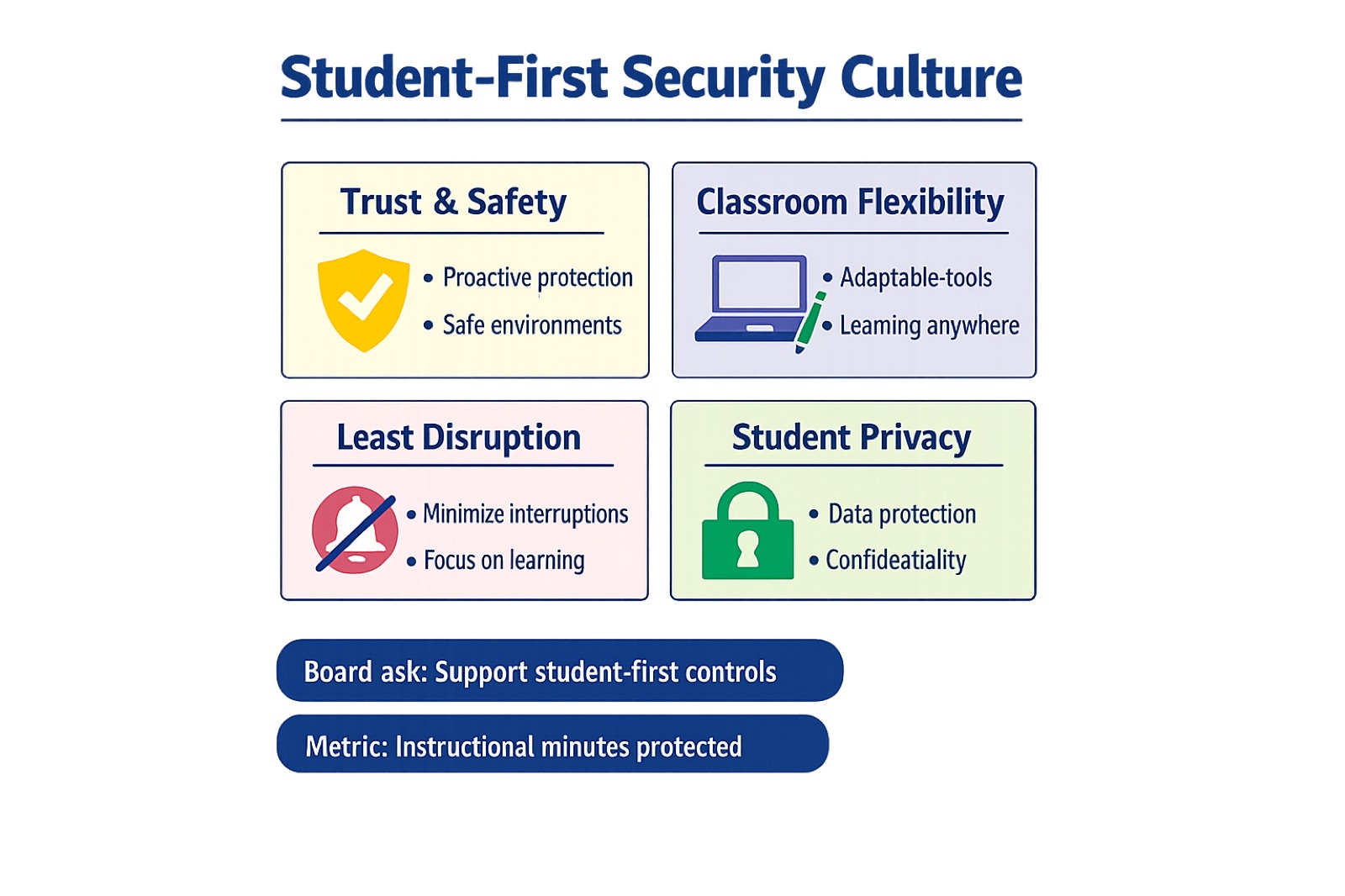
Figure: Four-pillar board slide (trust, flexibility, low
disruption, privacy) to reinforce the student-first framing.
Rubric Checkpoint
NIST CSF Function: GOVERN
Rubric Domain: Organizational Context
NIST CSF 2.0 Categories:
| Category | Code | Outcome |
|---|---|---|
| Organizational Context | GV.OC | Security decisions reflect educational mission and stakeholder needs |
| Policy | GV.PO | Student-first security approach documented in district policy |
This chapter addresses how districts balance security with their
educational mission. The Rubric evaluates whether your district has
documented this balance in policy and practice.
Key Maturity Indicators:
- Level 2: Security decisions acknowledge educational impact
- Level 3: Formal policy defines student-first security approach
- Level 4: Security measures are routinely adjusted for learning
needs - Level 5: Continuous feedback loop between security and education
teams
Assessment Tip: Use the Rubric to evaluate whether
your security policies explicitly address educational continuity as a
priority.
Real-World Tensions and
Solutions
The Substitute Teacher
Dilemma
One of the most common security challenges in K-12 environments
involves substitute teachers. When a teacher is absent, the primary goal
is ensuring instruction continues smoothly. For many educators, the
quickest way to give substitutes access to digital resources is sharing
their login credentials.
Lightfoot explains the educator perspective: “From their perspective,
it’s about minimizing disruption and ensuring learning continuity. They
might worry that if the substitute can’t log in quickly, students will
be off-task, or a lesson will be lost.”
This practice creates significant security vulnerabilities.
Substitute teachers gain access to systems they shouldn’t, and when
credentials are shared, it becomes impossible to track who accessed what
and when. The security team recognizes the risk, but the instructional
need is real.
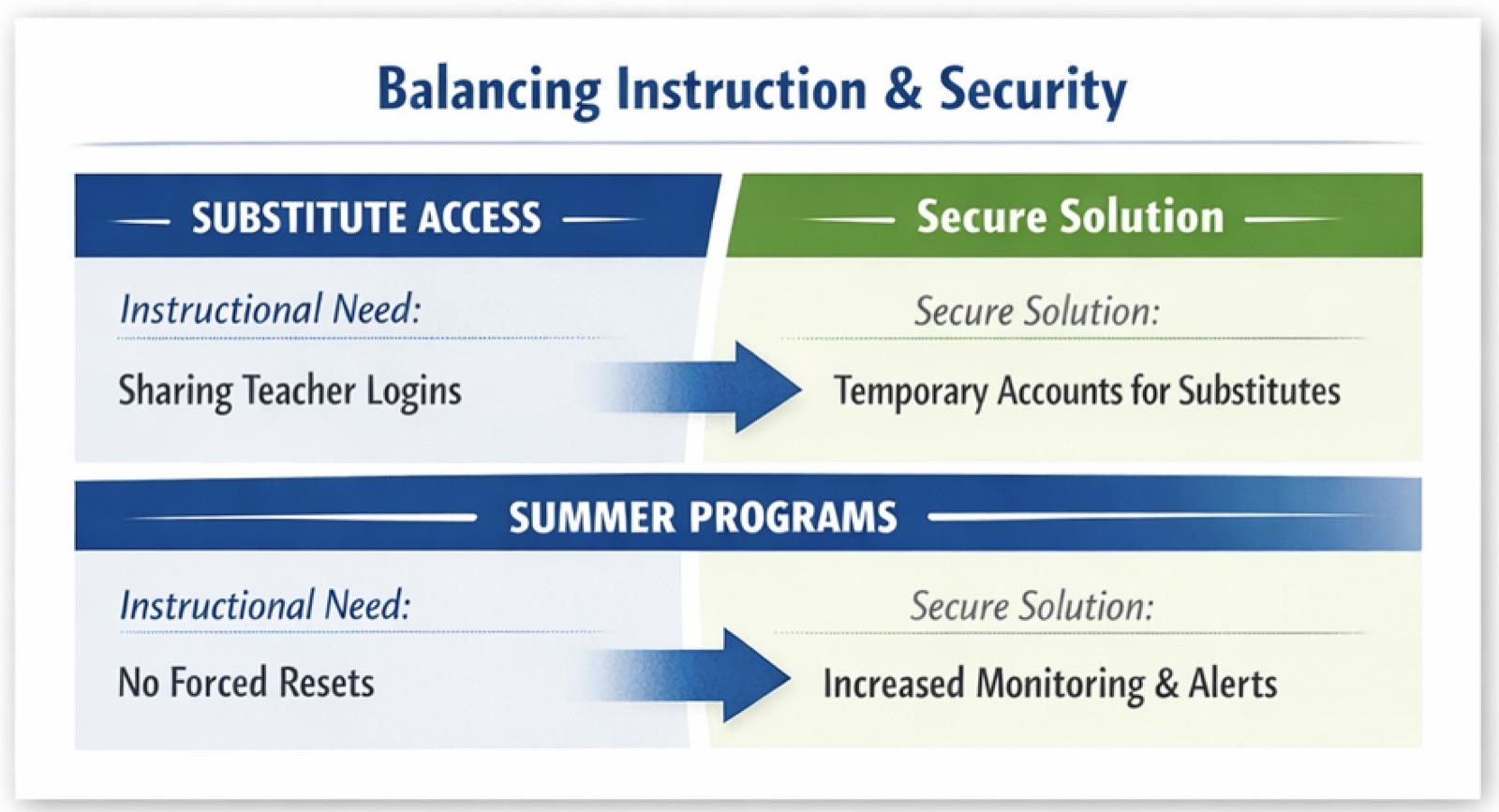
The solution isn’t to ignore the educator’s concern. It’s to build
systems that address both needs: temporary accounts for substitutes,
streamlined provisioning processes, or role-based access that can be
quickly assigned and revoked.
Summer Program Access
Conflicts
The student-first approach extends beyond the regular school year.
Many districts face conflicts between security best practices and summer
learning programs. Dickinson ISD has delayed mandatory password resets
until the new school year to avoid disrupting summer programs, summer
learning, or any student access needed for summer assignments or
activities.
This decision requires increased vigilance from the cybersecurity
team. “We’re being extra cautious this summer,” says Lightfoot. “We’re
paying special attention to any phishing attempts that appear to come
from student accounts, because we know those passwords haven’t been
refreshed. We’re also very closely monitoring logins from foreign IP
addresses for student accounts, as this could be a sign of a compromised
account.”
The result is a trade-off: increased monitoring burden on IT staff in
exchange for uninterrupted student access during critical learning
periods.
Student Device Management
The proliferation of student devices creates another layer of
complexity. A large district in Massachusetts, with 60 buildings, faces
constant challenges from students attempting to circumvent security
controls.
The district used edge network visibility tools to catch tunnel
switching that their managed SIEM solution missed. This type of
real-time detection and response is crucial when students will
continuously test security boundaries.
Voices from the Field
The Balancing Act
Dan Klimke, Product Manager, NetAlly
“Student creativity in circumventing security requires constant
vigilance. Kids are really smart, and we need to stay ahead of them. A
recent example where NetAlly’s CyberScope found an issue that other
solutions missed: The network team detected large amounts of tunneled
bandwidth being consumed. Students got around IPsec blocking by
initiating a hotspot on their iPhones, then dropping the tunnel on the
phone with tunnel switching to an open port. CyberScope caught the
issue. Problem solved.”
Voices from the Field
Cultural Transformation
Caroline Lightfoot, Director of Technology, Dickinson
ISD
“Cultural change requires understanding educational priorities. We’ve
found that successful security implementation comes from understanding
what teachers and administrators need to accomplish, then finding ways
to make security work with those goals rather than against them. When we
explain that security measures protect our ability to educate students
and maintain community trust, everyone understands the value
proposition.”
Dana Castine, Technology Director, Florida Union Free School
District
“State regulations provide strong cultural motivation. When we
explain that NYS Education Law 2-d requires specific security measures
to protect student data, it helps everyone understand that this isn’t
optional. It’s a legal requirement that protects our district and our
students. This creates a shared sense of responsibility across the
organization.”
Castine also tracks cultural success through metrics: “We track not
just technical compliance with state regulations, but how well our staff
understand and embrace their role in protecting student data. When
everyone from teachers to administrators takes ownership of data
protection, we know our cultural transformation is successful.”
Dan Klimke, Product Manager, NetAlly
“Student creativity drives K-12 security culture. Kids are really
smart, and we need to stay ahead of them. This reality has created a
culture where everyone understands that security is an ongoing challenge
that requires constant vigilance and adaptation. It’s not just about
following policies—it’s about staying one step ahead of creative
students who will always find new ways to test boundaries.”
Building Security
Into Educational Culture
Passing a cybersecurity assessment is only the beginning. To provide
lasting protection while maintaining compliance with education
regulations, schools must integrate security practices into daily
operations and organizational culture, with specific attention to the
unique dynamics of the K-12 environment.
“The biggest hindrance is often the sheer amount of work involved for
a small team,” notes Caroline Lightfoot. “We constantly have to make
sure our security measures don’t get in the way of what teachers need to
do, while still keeping student data safe and meeting all those
important privacy laws.”
When Security Becomes
Embedded
Security becomes effective in K-12 when:
- All staff understand student data privacy requirements and their
role in maintaining compliance - Security considerations are built into educational technology
decisions from the start - Digital citizenship curriculum incorporates age-appropriate security
awareness for students - IT teams and educators collaborate on balancing security with
educational access needs - District leadership views cybersecurity as essential educational
infrastructure - Security measures protect rather than impede the learning
environment
Timing Security
Implementation
Dickinson ISD has successfully integrated security into their
educational culture through collaborative approaches. “We’ve found that
implementing security measures during natural transition periods, like
the start of a new school year or during summer break, minimizes
disruption to learning,” explains Lightfoot. “The key is planning ahead
and communicating clearly with all stakeholders about what to
expect.”
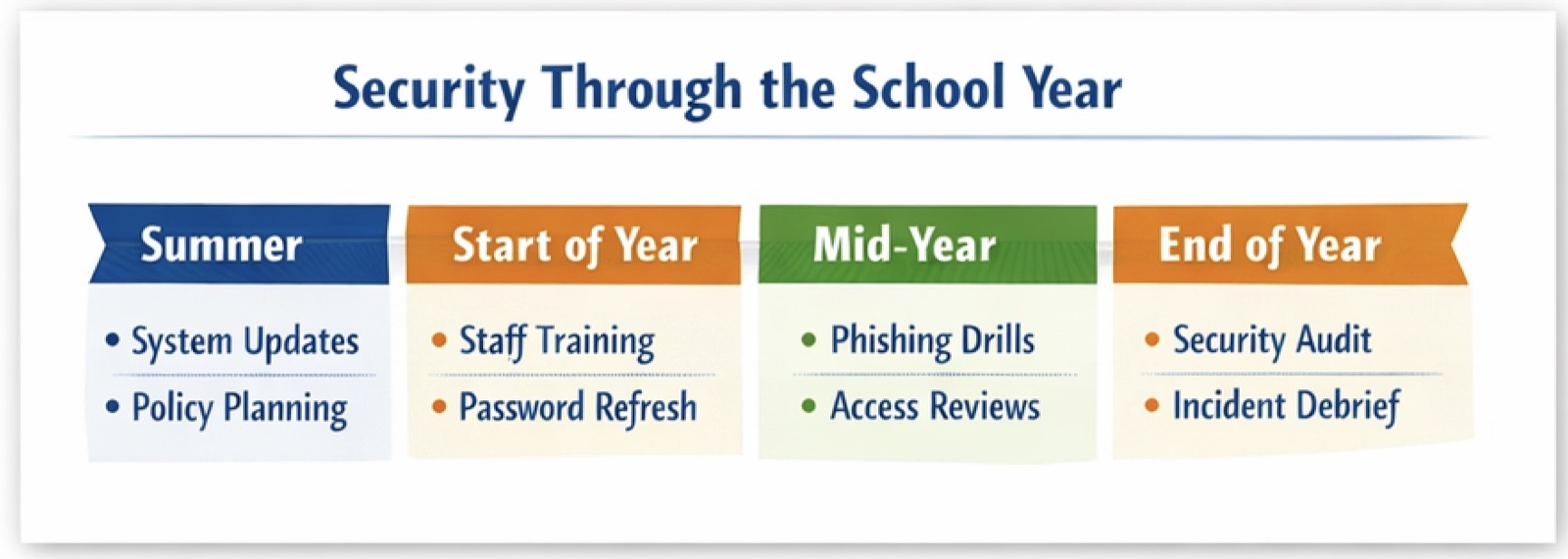
Schedule security reviews aligned with academic calendars:
- Summer: Major policy updates and system
changes - Start of year: Staff refresher training
- Mid-year: Progress assessment and adjustment
- End of year: Annual review and summer planning
Technical
Approaches for Student-First Security
Network Segmentation
with Learning in Mind
Effective network segmentation in K-12 environments requires
understanding the different user types and their needs. Students,
teachers, administrators, and guests all have different access
requirements and security profiles.
Dickinson ISD has implemented network segmentation that separates
students, staff, administration, and BYOD networks. Lightfoot describes
the impact: “The impact of this has been profoundly positive. If a
student device on the student network gets compromised, the malware is
largely contained within that segment. It cannot easily jump to the
staff network, access our administrative systems, or compromise teacher
laptops or sensitive student information systems.”
This approach provides security while maintaining the flexibility
that learning environments require. Students can access educational
resources without compromising administrative systems, and teachers can
use their devices without exposing student data to unnecessary
risks.
Edge Network Visibility
The student-first environment requires comprehensive visibility into
network activity, particularly at the edge where students are most
likely to attempt security bypasses. Traditional centralized monitoring
tools may miss activity that occurs at the network perimeter.
Edge network visibility tools can provide real-time detection of
unauthorized devices, unusual traffic patterns, and security bypass
attempts. These tools can discover all Ethernet, Wi-Fi, and Bluetooth
devices on the network, identify their locations, and determine if they
are authorized or potential threats.
The Massachusetts district uses this approach to quickly identify and
resolve network issues. The network manager describes the capability:
“The network tech can walk a building or the parking lot and quickly
characterize what is going on and if there are issues, then find them
fast.” This capability is crucial when students are constantly testing
security boundaries.
Adaptive Security Controls
Student-first cybersecurity requires security controls that can adapt
to the learning environment. This might involve:
- Time-based access controls: Restricting certain
activities during instructional hours while allowing more flexibility
during planning periods - Role-based permissions: Different access levels for
students, teachers, substitutes, and administrators - Context-aware security: Adjusting security measures
based on the user’s role, location, and time of day
These adaptive controls help maintain security without creating
unnecessary barriers to learning.
Practical Implementation
Guidance
Start with Understanding
Before implementing any security measures, understand the
instructional needs they might impact. Talk to teachers about their
technology requirements, identify critical learning applications, and
map out the daily technology usage patterns in your schools.
Gradual Implementation
When introducing new security measures, implement them gradually and
with extensive support. Dickinson ISD’s successful MFA implementation
involved hands-on training at each campus during faculty meetings. “This
direct, in-person support meant that most teachers and staff got the
help they needed right there to set it up,” says Lightfoot.
Monitor and Adjust
Student-first security requires continuous monitoring and adjustment.
What works during the regular school year may need modification for
summer programs, testing periods, or special events. Be prepared to
adjust security measures based on instructional needs while maintaining
overall security posture.
Communicate the Why
Help teachers and administrators understand why security measures are
necessary. When people understand the risks and the reasoning behind
security decisions, they’re more likely to support and comply with
security policies.
The Path Forward
Student-first cybersecurity doesn’t mean compromising security. It
means implementing security measures that work within the unique
constraints and requirements of educational environments. The key is
finding the right balance between protection and accessibility.
This balance requires:
- Understanding the instructional impact of security decisions
- Implementing adaptive security controls
- Maintaining comprehensive network visibility
- Providing ongoing support and communication
- Being willing to adjust approaches based on real-world feedback
The districts that succeed in this balancing act are those that view
cybersecurity as a support function for learning, not an obstacle to it.
They implement security measures that protect students and staff while
enabling the flexibility and access that modern education requires.
As K-12 cybersecurity continues to evolve, the student-first approach
will remain the foundation for effective security in educational
environments. The challenge is not choosing between security and
learning, but finding ways to achieve both simultaneously.
What Your Boss Should Know
The Bottom Line: Student-first security requires
meaningful additional IT staff time but prevents learning disruptions
and maintains community trust.
Board Decisions Required:
- Allocate additional IT budget for training and support during
security rollouts - Approve policy framework defining when instructional needs can
temporarily override security - Confirm staffing levels support hands-on implementation support
What Success Looks Like:
- Significantly fewer security incidents that disrupt instruction
- High teacher adoption rate for security measures
- Positive parent and community feedback on technology access
Why It’s Worth It: One security incident that
disrupts learning costs more than the entire student-first
investment.
Interactive Activity
Reflect
Where does today’s secure process create the most pressure for an unofficial workaround?
Apply the lesson
Record one friction hotspot, a safe 48-hour response, and one 90-day improvement.
Protect sensitive information. Use role titles and system categories. Do not enter student or staff records, credentials, network addresses, exploitable configurations, active incident details, or confidential vendor terms.
Interactive Activity
Build the boss brief
Explain how the proposed change protects learning as well as systems.
Use five parts: risk; learning impact; proposed action; decision or support needed; evidence of success.
Post-lesson rubric reassessment
Student-first controls are designed with educators, tested against school-day realities, and adjusted with evidence.
- Emerging — informal, reactive, or dependent on one person
- Developing — partly documented or inconsistently applied
- Operational — assigned, repeatable, implemented, and evidenced
- Leading — measured, rehearsed, integrated, and continuously improved
Use the same scale as the pre-assessment. Cite evidence of movement, or identify the next action if the rating did not change.