
3. Intro to the Brain
Live
Welcome to our lesson on the incredible workings of the brain — a vital part of understanding MindShifting. The brain is a highly complex organ, yet by taking a closer look at its basic structures and functions, we can gain insights into everyday reactions and choices. This understanding will shed light on how we can shift those responses to be more constructive.
In this lesson, we’ll break down the brain’s processes into a simplified, practical model to help you grasp the core ideas of MindShifting. Knowing how different parts of the brain contribute to your behavior allows you to better direct your attention and responses, fostering growth in emotional control, problem-solving, and relationship building.
Why This Matters:
- Better Self-Awareness: Recognize when you’re reacting automatically versus responding intentionally.
- More Effective MindShifting: Understand which parts of your brain to engage when shifting.
- Improved Emotional and Cognitive Control: Navigate everyday stresses with greater ease.
A Note on Simplification:
We’ll explore a simplified yet practical model of the brain in this lesson—one that helps us make sense of how automatic (heuristic) and emotional processes guide us, and how our prefrontal cortex can bring in higher-level thinking.
? Introduction & Learning Goals
In this lesson, you’ll learn:
- Three Parts of the Brain: You’ll get to know the three core systems involved in how you react, choose, and behave every day.
- Limbic System vs. Prefrontal Cortex: Learn about how these sections of the brain handle emotional reactions versus thoughtful planning.
- Caveat: A Simplified Model: Understand why our approach focuses on clarity rather than detail.
- Why This Model Matters: You’ll see how this brain-based framework can help you be more grounded, intentional, and resourceful in real life.
- Putting It into Practice: We’ll end with ways you can start applying this knowledge immediately in everyday challenges.
By the end of this lesson, you’ll have a clearer picture of the brain’s inner workings and be better equipped to recognize when you are defaulting to your automatic reactions. More importantly, you’ll start to see how you can shift from those automatic responses to more resourceful, intentional actions. Let’s embark on this journey towards using our brains in smarter, more efficient ways!
Topics in this Lesson
Our brains are incredible machines, designed to respond instantly to threats, quickly form habits, and also engage in deep reflection. In this part, we’ll focus on heuristics — mental shortcuts that guide much of your behavior automatically.
?Why This Matters:
Recognizing these different “modes” of the brain sets the stage for MindShifting. It explains why we sometimes act impulsively or emotionally, and how we can tap into more resourceful capabilities when we need them most.
What This Lesson Is About
In this Lesson, we’ll introduce a three-part model of how the brain makes decisions and takes action:
- Heuristics: mental shortcuts and patterns (see this concept explained below in detail)
- Emotional Brain: rapid, automatic responses
- Prefrontal Cortex (PFC): the slower, thoughtful part of the brain
This simplified model helps explain why we react the way we do and leads to the techniques of how we can shift toward more thoughtful, resourceful responses. Later, we’ll dive deeper into each of these brain components—understanding how they interact, how they influence our daily behavior, and how we can consciously manage those reactions to live and work more effectively.
What Are Heuristics?
Most of us already recognize emotional reactions (“That made me angry!”) or thoughtful planning (“Let me think this through…”), but we don’t always realize how often we’re relying on invisible habits and shortcuts—what psychologists call heuristics.
Heuristics are mental shortcuts—rules of thumb your brain uses to act quickly without analyzing every detail. Think of them as autopilot responses: learned patterns based on past experiences.
You use heuristics when you:
- Tie your shoes without thinking
- Navigate a familiar route
- Say “Bless you” when someone sneezes
You didn’t stop to reason it out—you just knew what to do.
These shortcuts come from genetics, repetition, social learning, and personal experience. Over time, your brain stores them so you can act fast in familiar situations. What we often call “instinct” or “intuition” is often just a heuristic doing its job.
Why They Matter:
Heuristics can be incredibly helpful:
- They save mental energy
- They help you act efficiently
- They reduce decision fatigue
But there’s a catch:
Because they’re fast and automatic, heuristics can misfire—especially when an old pattern is applied to a new or complex situation. For example:
- You assume someone is angry just because they’re quiet
- You delay starting a project because it feels too big
- You give up on a goal after one obstacle, then later regret not following through
In the next section, we’ll take this a step further. You’ll explore how heuristics work alongside your emotional brain and your prefrontal cortex, forming a system that reacts before you even realize it. We’ll look at how these three systems interact—and how you can begin to shift control back to the part of your brain that helps you act with intention, not just instinct.
How Your Brain Responds: Three Systems, One Fast Reaction
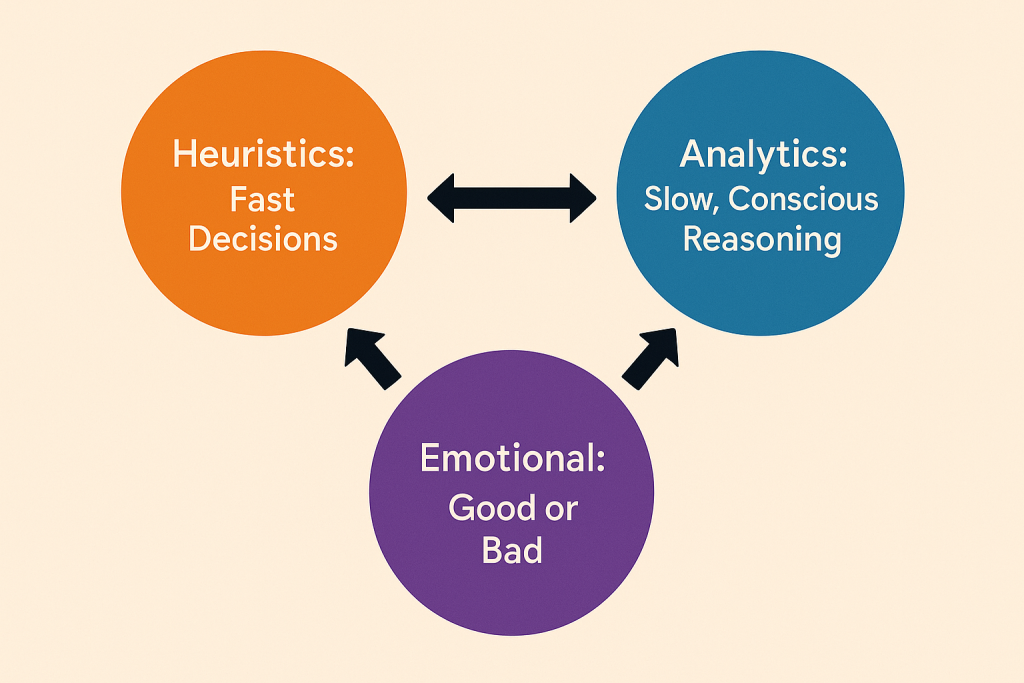
In the introduction, we explored how your brain isn’t flawed—it’s doing exactly what it evolved to do. But what does that actually look like in real-time? Most of the time, your actions and reactions are driven by three systems working in parallel:
Heuristics – quick patterns and shortcuts based on past experience
The Emotional Brain – fast, binary judgments: good or bad, safe or unsafe
The Prefrontal Cortex (PFC) – slower, thoughtful reasoning and regulation
In this topic, we’ll look more closely at all three. You’ll see how they work together—and how they sometimes work against each other.
Heuristics: Fast Decisions Without Thinking
What They Are
Heuristics are mental shortcuts or patterns you’ve practiced so often that they run on autopilot. You don’t need to think about them—they just happen.
Think of:
Tying your shoelaces
Driving a familiar route
Picking your usual coffee order
These are all powered by heuristics.
Why They Matter
Heuristics save your brain energy. Instead of analyzing every decision from scratch, you default to stored solutions. They’re fast, efficient, and usually helpful—but they can also lead you into habits that no longer serve you.
In the course introduction, we saw how heuristics shape everyday decisions. This module builds on that, diving deeper into when and why we rely on them—and how to know when to pause and take back control.
The Emotional Brain: Binary, Fast, and Powerful
Always Binary
At the emotional level, your brain is constantly labeling things as either “good” or “bad,” “safe” or “dangerous.” This black-and-white judgment system kicks in before you consciously realize it.
Fast and Emotional: How Your Brain Judges in an Instant
Emotional reactions form in less than one second—often in just 20–30 milliseconds. They’re fast because they evolved to protect you. If something might be a threat, your brain would rather overreact than miss the danger.
Even decisions that seem rational (like buying a car or choosing a college) start with emotion. Research shows emotions not only kick off the decision—they also cast the final vote.
How Fast Do the Heuristics and Emotional Brain Work?
In the first 20–30 milliseconds, two things happen simultaneously:
The emotional system scans the situation and flags any threat—real or imagined.
Your heuristics jump in with suggestions: familiar reactions based on past patterns.
Before your rational brain even shows up, a direction is already chosen. That’s why you often act before you think—because your emotional brain and heuristics beat your prefrontal cortex to the punch.
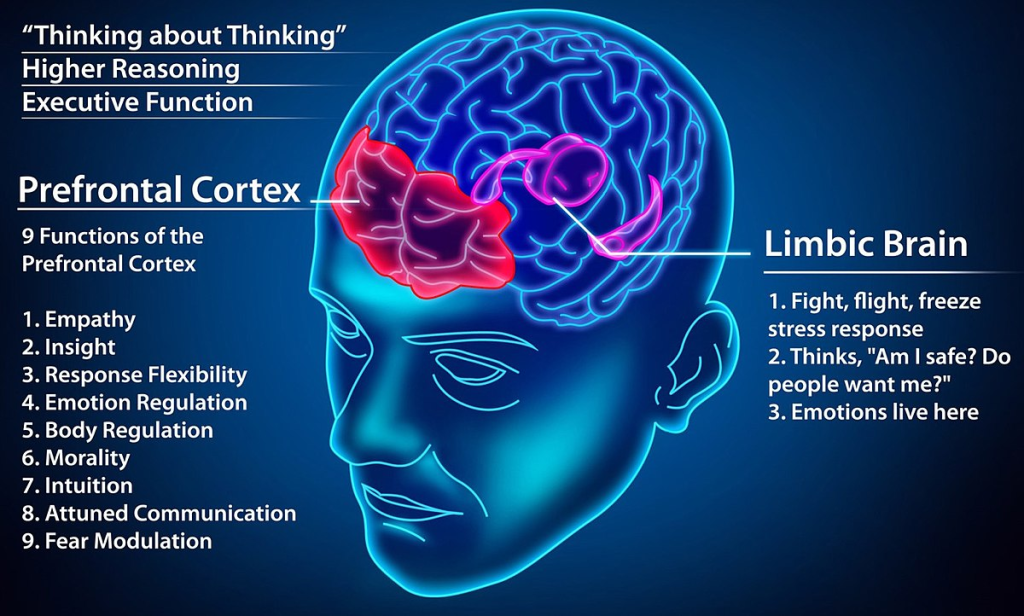
The parts of the brain that rapidly propose actions and that emotionally judge the situations and actions are part of the limbic system, which we often call the survival brain, because it evolved so that organisms could survive against threats and dangers.
This system is lightning fast and energy efficient, which is great for survival—but not always helpful when you’re trying to grow, reflect, or change patterns.
Prefrontal Cortex: Slower, Smarter, Often Late
What Makes Us Human
The prefrontal cortex (PFC) is the brain’s most advanced region—supporting functions like empathy, reflection, planning, and long-term thinking. While all mammals have some degree of prefrontal processing, it is the complexity and development of these functions in humans that truly sets us apart.
It evolved around 24 million years ago and supports what we call “sage” behavior—reasoned, flexible, empathetic responses to the world around us.
The Core Functions of the PFC
While different researchers offer different lists, common PFC functions include:
Empathy & attuned communication
Self-awareness & insight
Emotional & body regulation
Response flexibility & fear modulation
Intuition & moral reasoning
Slower to Arrive
The PFC typically takes 2–3 seconds to fully engage. That’s often too late—your limbic system may have already chosen your reaction. And instead of overriding it, the PFC often jumps in to rationalize that reaction:
“I’m tired, I’ll do it tomorrow.”
“They were being rude—of course I snapped back.”
“I deserve a break, just 10 more minutes on my phone…”
These are not logical decisions, they’re emotional or habitual justifications dressed up in logic. But once you recognize the story, you can ask:
“Is this story helping me?”
“What might I do instead?”
This is the heart of MindShifting—noticing your brain’s fast stories and gently shifting them.
What’s Next: From Awareness to Action
Now that you’ve seen how your heuristics, emotions, and rational brain interact, we’ll explore how this system affects behavior. You’ll learn how to recognize when your fast brain is in the driver’s seat—and how to pause, reflect, and shift toward your PFC when it matters most.
In the next section, we’ll break down the limbic system’s five fast reaction modes: fight, flight, freeze, habit, and mimicry—and show how to navigate them.
The Limbic System (Emotion + Heuristics)
Estimated Age: ~500 million years
Sometimes called the “reptilian” or “survival” brain, the limbic system evolved to help animals (including us) survive in rapidly changing or dangerous environments.
In this course, we use “limbic system” as a shorthand for two systems that often activate together:
Emotional centers like the amygdala (fear, anger, desire)
Heuristic pathways (automatic habits, past-pattern shortcuts)
These aren’t the same structures biologically—but in real-life reactions, they act as one fast-response team. When something happens:
Your emotional centers instantly judge it: safe or dangerous, good or bad
Your heuristics suggest what you’ve done in similar situations
- Your emotional centers approve one of the heuristics suggestions
The result? A lightning-fast decision—usually before you’re even aware of it.
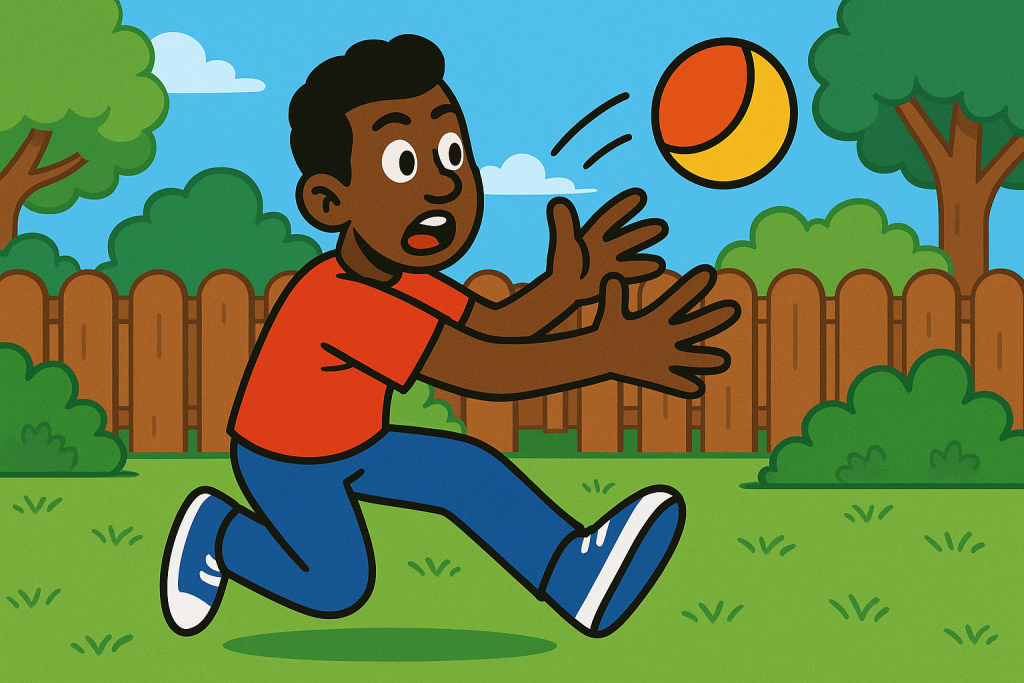
Imagine that you are walking and out of the blue, someone tosses you a ball. Without thinking you reach up and catch it.
But now imagine that you are walking and you see some broken glass coming right at your face. In this case, you’d duck or jump out of the way.
In either case, you had fractions of a second to decide what to do, and you reacted instinctively. That’s how fast your limbic system judges whether or not you are facing a threat and how to react.
Binary Thinking in Action
The limbic system doesn’t recognize complexity. It categorizes everything into simple, black-and-white labels:
- Good / Bad
- Safe / Dangerous
- Yes / No
This works great when you’re crossing a street or facing a threat—but it’s less helpful in complex situations like negotiations, relationship tension, or modern work stress, where nuance and patience are key.
The Prefrontal Cortex (PFC)
Estimated Age: ~24 million years
This part of the brain developed later, especially in mammals—and it’s highly developed in humans. It’s responsible for what we think of as higher-level thinking.
The PFC is responsible for these types of activities:
- Planning
- Emotional regulation
- Empathy and social awareness
- Insight and moral reasoning
- Flexibility and creativity
- Problem-solving
- Self-awareness and reflection
- Focus and attention control
- Fear modulation
Those are important, but they generally aren’t life threatening, so there’s a catch.
Slower to Activate
The PFC takes a couple of seconds to fully engage. That means the limbic system usually acts first. In fact, under stress or threat, the PFC often shuts down temporarily—so the faster system can take over.
And if the limbic brain has already “decided,” the PFC doesn’t necessarily override it—it might just rationalize it.
Limbic Decisions We Think Are Rational
Here are three everyday examples where the limbic system made the decision, but the PFC told the story afterward:
1. Avoiding a challenging task:
You have a big report due in a week and you don’t even know where to begin or what it expected or how to find the data that you need to analyze. You are feeling anxious and overwhelmed. Your limbic reaction is to freeze or put it off, but your PFC justifies that by giving you the convenient excuse, “I can push this off for now.”
2. Snapping at someone during a stressful moment:
You used up the toilet paper and didn’t replace it. Another member of the house comes in and says, “who was the inconsiderate person who used up the toilet paper and didn’t replace it?” You respond, “Why do you always make a big deal over these minor things. Get over it and grow up.”Your retort was likely made without much thought, but on reflection you probably justify it to yourself, “They were being rude—anyone would have reacted like that.”
3. Scrolling social media instead of focusing:
You are just about out of clean clothes, but your phone chirps and you start scrolling through messages and posts. That decision was instantaneous, but your PFC might justify it with the story, “I needed a mental break to refresh my mind.”
These moments don’t mean we’re broken—they mean our survival brain is doing its job. But recognizing this helps us pause, reflect, and choose when to re-engage the PFC for a more resourceful response.
Coming Up Next
In the next topic, we’ll revisit a key principle: this model is a helpful simplification, not a neuroscience textbook. We’ll look at why it works so well for practical self-awareness—and how you can start recognizing which system is driving your own choices in real time.

The modern car has over 25,000 parts. Do you know what each one does? Can you even name them?
Yes—the human brain is far more complex than what we’ve just described.
- It has about 100 billion neurons.
- Over 100 distinct regions—like the amygdala, hippocampus, basal ganglia, and prefrontal cortex—all interact in dynamic, layered ways.
We’re not ignoring that complexity. Neuroscience is vast and still evolving.
But here’s the key: You don’t need to be a neuroscientist to get better at managing your reactions.
Why We Use This Simplified Model
In MindShifting, we use a three-part model:
- Limbic System = Emotion + Heuristics
(Fast, automatic reactions like freeze, habits, or emotional outbursts) - Prefrontal Cortex (PFC) = Sage Thinking
(Slow, thoughtful responses like empathy, reflection, and problem-solving)
This three-part model isn’t 100% biologically accurate, but the simplification is useful. Using this model, you will gain a clear understanding to questions like:
- “Am I reacting automatically—or responding intentionally?”
- “Is this fear talking—or thoughtful planning?”
- “Is my PFC even online right now?”
MindShifting Starts with Awareness
This model is your daily compass. It helps you spot moments when your limbic system hijacks your behavior, and gives you the tools to:
- Pause
- Shift your mindset
- Re-engage your resourceful brain
That’s not oversimplification—it’s empowerment.
So while the full picture of the brain is complex, this practical model helps you do something the full map never could:
Recognize and redirect your patterns in real time.
And that’s what MindShifting is all about.
During this course, you will see interactive exercises, such as the one below, and you’ve already tried an AI Mentor interaction.
This Interactive exercise is designed to help you internalize the main concepts covered so far, so that you don’t have to think about them as new content is covered, and then the AI interaction will give you a practical example of using these concepts.
Note the blue status line on the bottom of the interaction. This indicates how far you have progressed and whether you have finished the exercise.
? Interactive Exercise “Which Part Is Working?”
Read each quote and pick which functions of the brain are most likely making the decision.
? AI Mentor Interaction: “Limbic or Resourceful?”
Goals
In this conversation, you’ll reflect on how your brain typically responds in real-life situations. You’ll practice recognizing moments when you acted automatically—through habits or emotional responses—and when you used your prefrontal cortex to respond thoughtfully. This exercise builds your ability to notice the difference between reactive and resourceful modes, which is key to MindShifting.
Remember, Coach Robbi is an AI avatar, not a real person. We have tried to set this up so that it asks you about your experiences to help you increase your ability to be self-aware. Sometimes the AI will go off-track and take you in another direction or start offering advice. If this happens, please feel free to end the interaction; and you can restart it if you feel that would be helpful.
Instructions
Chat with the Coach Robbi like you would with a coach. Share recent examples from your daily life:
Prompt: Recall one situation where you acted instinctively, and one where you paused to think.
Question: What was different about how each situation felt? What triggered each response?
Action: Jot down a sentence about when your limbic brain tends to take over—and one about how you know when your PFC is engaged.
? What You’ve Just Practiced
One of the first steps in becoming more resourceful is recognizing how you respond. Are you reacting from habit and emotion—or pausing to choose your response thoughtfully?
By reviewing your own examples in this conversation, you’ve taken an important metacognitive step. You’ve practiced observing your own mental processes—and that’s the gateway to real growth.
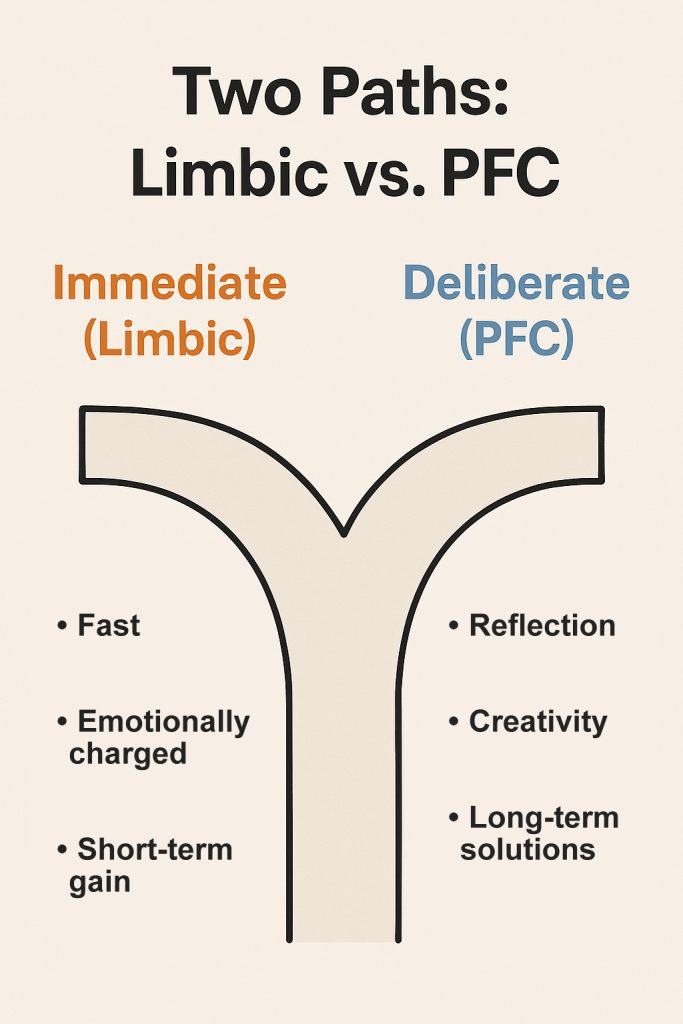
The model we’re using in this course divides the brain into two key systems:
The Limbic System, which drives fast, reactive behavior through emotions, habits, and survival instincts.
The Prefrontal Cortex (PFC), which supports slow, thoughtful responses like empathy, problem-solving, and self-reflection.
This division is a simplification—but a powerful one. Here’s why it matters.
The Goal: Awareness and Choice
MindShifting begins when we recognize which system is in control at a given moment.
Are we in limbic mode—defaulting to fight, flight, freeze, habit, or mimicry?
Or is our PFC engaged, letting us choose thoughtfully, rather than react instinctively?
The value of this model is that it gives us a clear way to pause and evaluate. Once we can tell we’re in a reactive state, we get a moment of choice:
Do I want to stay in this pattern—or try a different, more resourceful path?
The Course Roadmap
Much of the rest of this course is about learning how to:
- Notice when you’ve slipped into a limbic reaction,
- Shift from autopilot into awareness,
- Tap into your prefrontal cortex to respond with creativity, clarity, and compassion.
It’s not about shutting off your emotions or instincts—they’re valuable.
It’s about learning when and how to switch drivers.
That’s why this model is so useful:
It doesn’t just describe the brain—it gives you a map for navigating real-life moments.
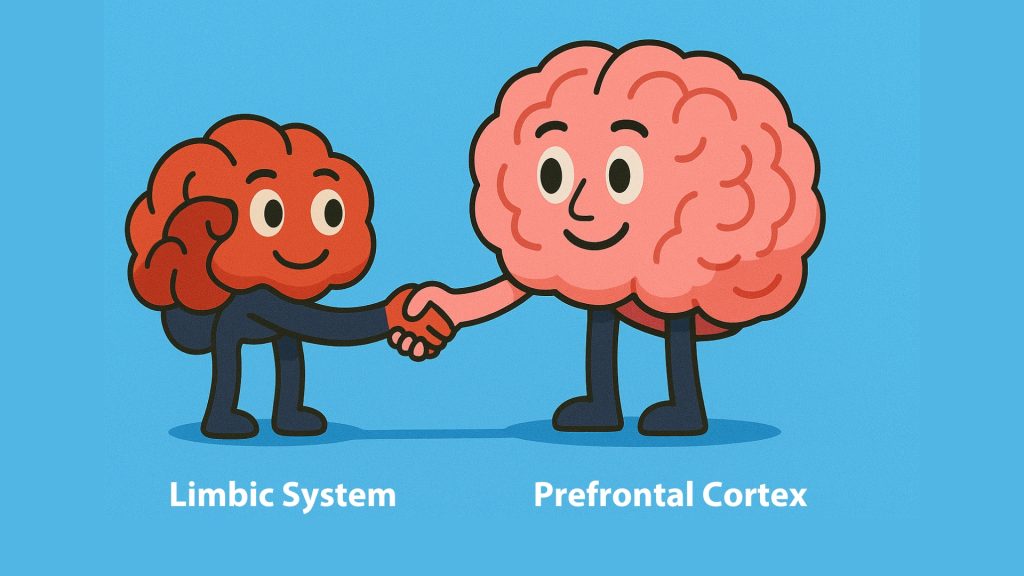
What are some of the differences between when the Limbic brain is driving our decisions and when we are resourcefully using our prefrontal cortex?
Key Points
Limbic / Survival Mode | Prefrontal Cortex / Resourceful Mode |
|
Extremely fast 0.02 seconds | Slower, 2-3 seconds |
|
Binary, Good/Bad, Danger/Safe |
Nuanced, possibilities |
Limbic reacts and the PFC justifies | PFC explores information and considers alternatives |
| Decisions are made emotionally, and any opposition results in fight/flight/freeze | The situation is assessed, alternatives considered, decisions are ultimately emotionally decided but left open to other possibilities |
? Practical Takeaway:
Next time you feel strong emotions or find yourself auto-reacting, ask:
- “Is this a knee-jerk limbic reaction?”
- “Should I give my PFC a moment to engage, so I can handle this more thoughtfully?”
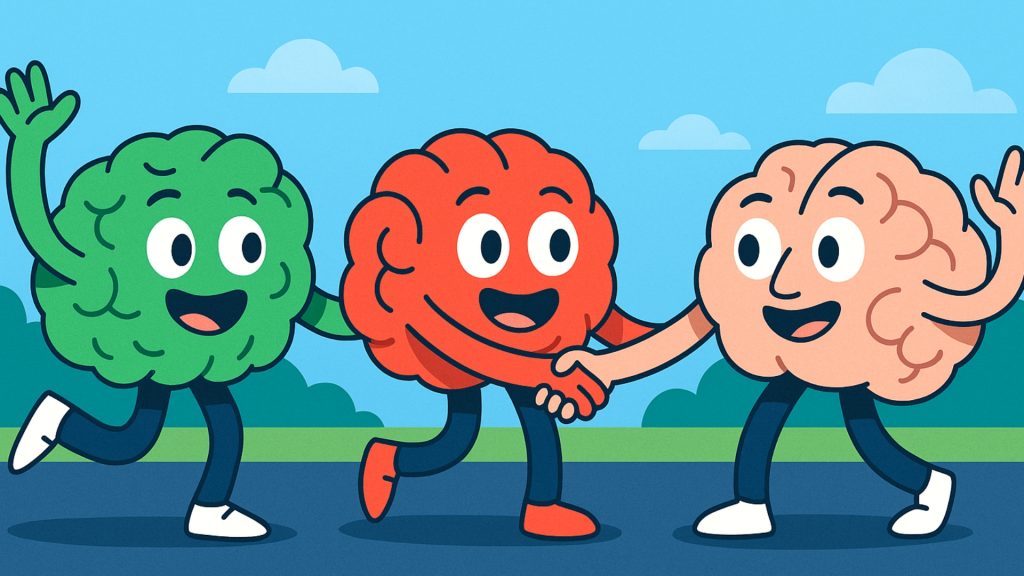
You’ve now seen how the brain’s three parts—heuristics, emotional, and PFC—dance together to shape our behavior. We also introduced the limbic system (emotional + heuristics) vs. the prefrontal cortex distinction, with a caveat that we’re simplifying a very complex organ.
? Key Takeaways
- Your brain uses multiple systems to guide your behavior—some fast and automatic, others slow and reflective.
- Understanding the brain’s structure helps you see why you sometimes react before you think.
- The limbic system handles emotional and survival-based reactions, while the prefrontal cortex supports thoughtful, intentional responses.
- This course uses a simplified model of the brain to make complex ideas easier to apply in real life.
- With this knowledge, you’ll be better prepared to recognize unhelpful patterns and shift toward more constructive actions.
- Knowing how your brain works is the first step toward mastering how you respond to challenges.
Next Steps in MindShifting
In lesson 4, we’ll dive deeper into the limbic brain itself—its 500-million-year-old survival instincts, rapid detection of threats, and how it triggers hormones that shape our actions. Understanding the limbic system is crucial to spotting fear-based or binary mindsets before they hijack us.
And in lesson 5, we’ll explore the prefrontal cortex, also known as the Sage brain—the part of your mind responsible for reflection, creativity, and self-control. You’ll learn what activates it, what shuts it down, and how to bring it online more often.
Remember: This entire framework is about empowerment—once you see how your brain’s “fast and slow” systems operate, you gain the ability to steer them toward more resilient and resourceful outcomes.