
9. Other Types of Certainty
Live
Welcome to another important step in our MindShifting journey. In this lesson, we will be exploring different kinds of certainties and how they shape our reactions and decisions. Understanding these matters immensely as it helps in becoming more mindful and less reactive in our challenging everyday moments.
Certainties are those statements or beliefs we might hold strongly, such as ”I have to do it this way” or ”This person is wrong.” These absolutes often arise from our limbic brain, which, as we learned, can lead to quick, black-and-white conclusions. Such thinking can limit our openness to new ideas and hinder mindful problem-solving.
Recognizing these certainties allows us to engage our prefrontal cortex, the part of the brain responsible for reflective thinking or metacognition. When we’re aware of certainty phrases like ”I must,” ”They’re always…,” or ”This is the only way,” it becomes a cue to pause, question, and re-evaluate our perspectives.
In this AI video simulation, the AI avatar Maribel will introduce you to a couple having a conversation about their financial worries.
Why This Matters
Spotting absolute statements in our thoughts helps us shift from a reactive state to one of curiosity and openness. This awareness is key to better understanding our minds and interacting more constructively with others. It’s about moving from fight, flight, or freeze responses to a place where nuanced thinking leads the way.
? Introduction & Learning Goals
In this lesson, we will delve into:
- How limbic-based certainty sounds in everyday thoughts and speech.
- Examples that highlight these certainties in action, both personally and in others.
- The role of metacognition—Topic 9.2 is a deep dive on how noticing our certainty reactivates reflective, flexible thinking.
- Simulations and real-life examples to help you spot these thought patterns in action.
As we unravel these topics, you’ll gain practical tools to foster more open-mindedness and adaptability in your daily life. By embracing indirect approaches to certainty—using curiosity and reflection—you can enhance problem-solving and strengthen connections with others.
Let’s begin our exploration into these intriguing aspects of certainty and start building skills for a more aware and adaptive mindset. Ready to transform your reactions and understand your certainties? Let’s dive in!
Topics in this Lesson
In earlier modules, we explored how “I can’t,” “Perhaps I can,” and “I know I can” each reflect distinct mindsets. However, certainty can show up in a variety of other ways, such as:
- “I have to do it this way.”
- “This person is wrong.”
- “This is right, that is wrong.”
- “It must be done now!”
These statements often occur when our limbic brain quickly categorizes issues or people in black-and-white terms. The result can be less open-mindedness, minimal curiosity, and a strong push toward fight/flight/freeze. Recognizing these certainties is a key step in mindful, reflective thinking—i.e., metacognition.
Why This Matters: By spotting absolute or definite statements (“I must,” “They’re always…,” “This is the only way”), we can pause to question them, re-engaging our prefrontal cortex for more nuanced thinking.
Examples of Limbic-Based Certainty

“I can’t”
- Already discussed: a final, no-resourcefulness stance.
“This person is wrong”
- Immediate labeling, leaving no room to consider partial correctness or shared viewpoints.
“From a habit of confirming”
- A rigid stance often driven by heuristic habit or fluency—defaulting to what’s familiar instead of considering alternatives. This kind of limbic reaction bypasses critical thinking and can block adaptation or innovation.
“This is right, that is wrong (so many issues in society, work, families, etc.)”
- Quick classification, fueling potential conflict or echo chambers.
Why Are They Limbic?
- Binary conclusions are a sign of limbic thinking with rationalizations instead of deep thinking.
- They often trigger or come from fight/flight/freeze—or from a habit of confirming what we already believe, known as confirmation bias or from copying what others are saying or doing.
Definition & Why It Matters
Metacognition—also known as self-awareness—is your brain’s ability to observe your own thoughts and patterns. It’s what allows you to hit the pause button and say, “Wait a minute… am I reacting or actually thinking?”
The moment you catch yourself in a rigid, black-and-white mindset (“This is just how it is”), you’re doing metacognition. That simple shift—from unconscious limbic reaction to conscious reflection—activates your prefrontal cortex and gives you the power to respond more wisely.
Metacognition is one of the most powerful skills in the MindShifting toolkit. It helps you spot when you’re reacting out of habit or emotion, and invites curiosity, flexibility, and better decisions.
Why We Resist Change: Confirmation Bias
Before we explore how to shift rigid thinking, we need to understand one big roadblock: confirmation bias.
This is your brain’s natural shortcut for staying safe—by sticking with what you already believe. It makes it easier to notice supporting evidence, while ignoring or rejecting anything that doesn’t fit.
It’s fast. It feels comforting. But it can also block growth.
Let’s look at three real-world examples.
Example 1: Judging a Student
Here are two possible judgments about the same child. Notice how the judgment influences how the adult reacts to that child’s action.
- Person A: “This student is a troublemaker.”
- Person B: “This student is a good kid.”
Trigger: The student forgets their homework.
- Person A says: “See? They’re lazy.”
- Person B says: “That’s not like them—they must’ve had a rough morning.”
Same event, different interpretations. Both are seeing the student through the lens of their pre-existing beliefs.
Example 2: Political Dialogue
Here are two different judgments by people about their group as opposed to other groups, and then how they might react when a leader of one of the groups is caught saying something.
- Side A: “My side always tells the truth.”
- Side B: “My side cares more about people.”
Trigger: A politician is caught misrepresenting facts.
Each side:
- Dismisses the issue when it’s “their” side
- Points fingers when it’s the “other” side
- Uses biased sources to prove their view
Result? Nobody questions their own beliefs—and meaningful dialogue disappears.
Example 3: Workplace Change
How we react to technology is dependent on our mindset toward technology and change in general.
- Manager A: “New tech always causes problems.”
- Manager B: “Change is always an upgrade.”
Trigger: A new software rollout causes confusion.
- Manager A: “Told you—this was a bad idea.”
- Manager B: “It’s just growing pains. People hate what’s good for them at first.”
Again, same event. Two stories.
Why Direct Confrontation Doesn’t Work
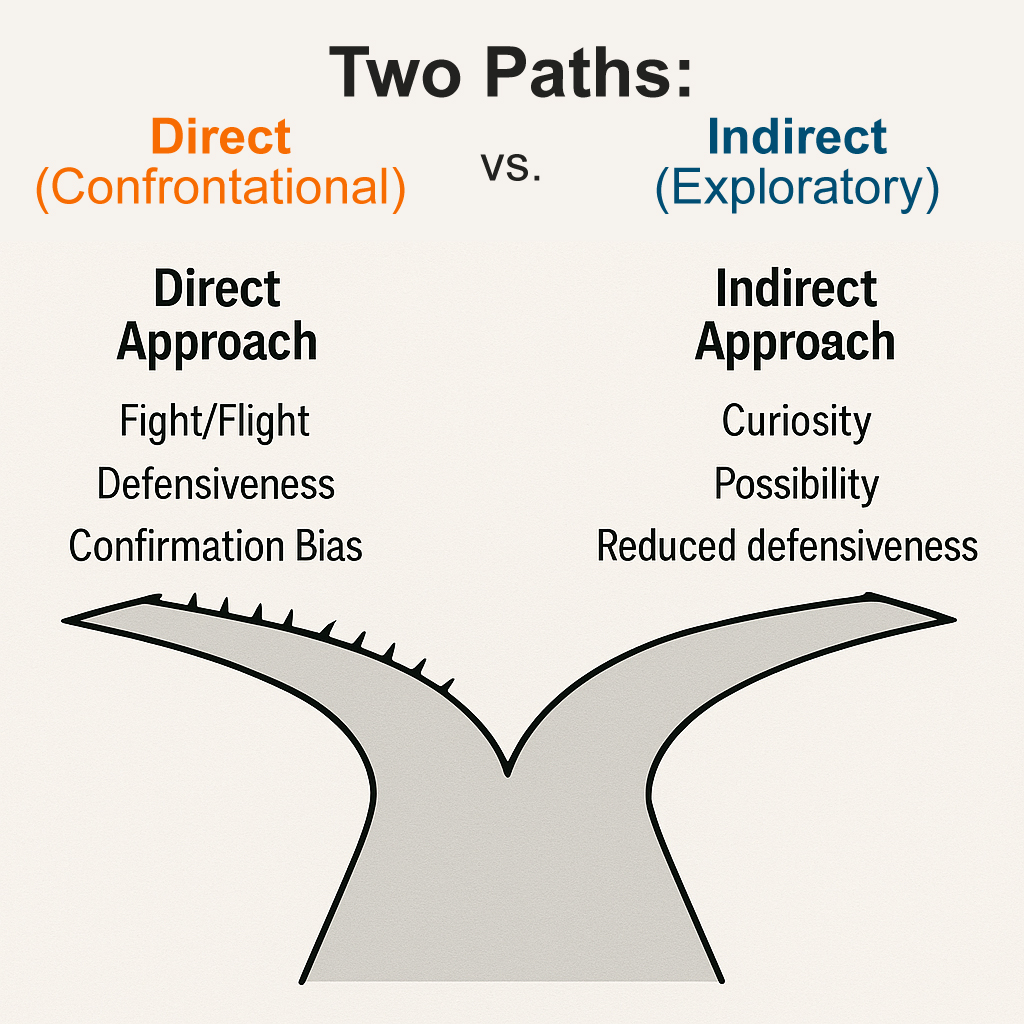
When we challenge someone’s belief head-on, their limbic brain lights up—it feels like a threat. The result? Fight, flight, freeze… and even stronger bias.
Direct approach (not recommended):
- “You’re wrong.”
- “Stop being so biased.”
- “That’s ridiculous.”
These may feel satisfying—but they rarely open minds.
The Power of Indirect Approaches
Instead of confrontation, try curiosity:
- “What makes you feel sure about that?”
- “Could there be another explanation?”
- “What might we be missing?”
- “Is there a different way to look at it?”
These indirect questions reduce the threat level, calm the limbic system, and invite the PFC to re-engage.
But a quick note: Even indirect approaches don’t always work. If someone is already angry, anxious, or doesn’t trust you, their limbic system may still shut the door. That’s why safety and timing matter too.
This Isn’t Just About “Them”
We all have confirmation bias—including you.
The next time you feel totally certain, black-and-white, or dismissive of alternatives, pause and ask:
- “What am I not seeing?”
- “Am I reacting, or am I reflecting?”
- “Could I say to myself, ‘Perhaps there’s more to this’?”
We’ll explore ways to shift your own thinking in the next topic.
? Summary: Confirmation Bias & Metacognition
- Metacognition = Self-awareness. It’s your ability to observe your own thinking.
- Confirmation bias is a normal survival shortcut—but it limits dialogue, growth, and creativity.
- Direct confrontation often reinforces bias.
- Indirect, curious questions can open minds—but only when the brain feels safe.
- This applies to you, too. Use indirect questions to challenge your own certainties and spark reflection.
Up next: We’ll practice how to gently shift rigid thinking—both in ourselves and when supporting others.

Here are 10 examples where someone might be very certain and how confirmation bias could manifest:
| Certain | Confirmation Bias | Possible Question | |
| Political Views | “I’m absolutely sure my political party’s policies are the best for the country.” | Only watching news channels or reading articles that align with their party, while dismissing or criticizing sources with opposing viewpoints. | “What are the strongest arguments made by people who disagree with me, and have I truly considered them?” |
| Parenting Styles | “I know my way of disciplining my kids is the most effective.“ | Seeking out parenting books or websites that support their methods and ignoring studies that suggest alternative approaches might be better. | “What evidence exists that contradicts my approach, and am I willing to test alternatives?” |
| Dietary Choices | “The diet I follow is the only way to be truly healthy.” | Focusing on testimonials and anecdotes that praise their diet while dismissing scientific studies that offer conflicting evidence. | “Am I open to changing my mind if new, reliable scientific evidence emerges about nutrition?” |
| Investing Strategies | “My investment strategy is guaranteed to bring the highest returns.” | Paying close attention to success stories that validate their strategy and downplaying or ignoring instances of failure. | “What are the risks I might be overlooking, and am I prepared for the possibility of being wrong?” |
| Evaluating Employees | “I’m a great judge of character, and I know who will be a good employee.” | Focusing on the positive traits and overlooking potential red flags of a candidate they like, or vice versa for a candidate they dislike. | “What are the other possible causes of this problem, and have I thoroughly investigated them?” |
| Diagnosing a Problem | “I know exactly what’s wrong with my car/computer/appliance.” | Only testing solutions that fit their initial diagnosis and ignoring other possible causes. | “Am I listening to the suggestions of others, or am I letting my gut feeling cloud my judgment?” |
| Beliefs About People | “People from that town/background are all untrustworthy/lazy/etc.” | Remembering instances that seem to support their stereotype and forgetting or dismissing examples that contradict it. | “Am I judging individuals based on stereotypes, or am I seeing them as unique individuals?” |
| Evaluating a Relationship | “My partner is definitely cheating on me/is my soulmate.” | Interpreting neutral actions in a way that confirms their suspicion or idealization, while ignoring evidence to the contrary. | “Am I being fair to my partner, or am I focusing only on evidence that supports my existing beliefs?” |
| Interpreting News Events | “The media is biased against my viewpoint.” | Only trusting news sources that align with their worldview and labeling others as “fake news” without critical evaluation. | “Am I getting information from a variety of sources, and am I critically evaluating their credibility?” |
| Self-Perception | “I’m a very organized/creative/athletic person.” | Remembering instances where they exhibited that trait and forgetting or downplaying times when they were disorganized/uncreative/unathletic. | “Am I being honest with myself about my weaknesses, and am I open to feedback that might help me improve?” |
Certainty can make someone selectively perceive information, leading to biased judgments and decisions. How can we be more creative, exploratory, and innovative?
Self-Awareness: understanding that we are certain or sure of something is the first step.
Asking questions: When we feel certain, perhaps we can ask questions to ourselves to open ourselves up to other perspectives and better outcomes, such as:
- If I had to argue this from the opposite viewpoint, what might be my strongest points?
- What are three other ways I could approach this?
- What would need to be true for my current thoughts to be wrong?
- How might the people who disagree with me be 10% right?
- If this doesn’t work, why might it have failed?
By now, you’ve seen how your limbic brain—the fast-acting survival system—automatically reacts to perceived threats. It defaults to one of five instinctive responses: fight, flight, freeze, habit, or mimicry. These responses evolved to keep us alive, and in many situations, they still serve us well.
But here’s the catch:
In today’s complex world, those instinctive reactions are not always helpful—and sometimes, they can make things substantially worse.
When we’re under pressure, our first move is often limbic. Improving how we respond in those moments depends on two key factors:
- The quality of our heuristics.
- Our ability to recognize when we’re in a limbic state—and shift into a more reflective, resourceful mindset.
Skill #1: Build Better Heuristics (Helpful Habits)
Our brains love shortcuts—also called heuristics. These mental habits guide fast decisions, just like muscle memory in sports. The goal isn’t to erase heuristics—it’s to upgrade them.
Think about it:
You didn’t always know that 4 × 3 = 12. You learned it by seeing the need, learning the pattern, and practicing it repeatedly. Eventually, it became automatic.
We can do the same thing with emotional and social responses.
You’ve already developed thousands of heuristics:
- You only needed to touch a hot stove once to learn to avoid it.
- You instinctively check emails from your boss right away.
- You know which colleagues or friends are most likely to be helpful.
- You can usually troubleshoot minor tech issues without thinking twice.
These are all learned mental shortcuts that save time and energy.
Examples of Better Heuristics You Can Train:
- Pausing before reacting in a disagreement
- Saying “Tell me more…” instead of interrupting
- Taking a deep breath when you feel overwhelmed
- Asking, “What else might be going on here?” before assuming the worst
Each time you practice a new response, you’re rewiring your fast-reaction system. Over time, your brain will offer these healthier defaults—even when you’re stressed.
?Key Takeaway: Just as practice builds physical fluency which makes you stronger in sports, practicing and rehearsing responses to situations builds cognitive fluency makes you more effective in real-life situations.
Skill #2: Develop Metacognition (Thinking About Thinking)
The second skill might be even more powerful: metacognition, or self-awareness in real time.
Metacognition is the moment when you realize:
- “I’m reacting with habit.”
- “I’m making a snap judgment.”
- “I don’t have to do this—I could choose differently.”
This skill allows you to pause the autopilot and create space between trigger and response. And in that space? You get your best thinking back.
Why Metacognition Wins:
- It reduces the control of the limbic system, calming the emotional brain.
- It activates your prefrontal cortex, bringing back creativity, empathy, and long-term planning.
- It opens the door to reframing, reinterpreting, and re-choosing.
Example in Action:
You get a curt, abrupt email from a colleague.
- Without metacognition: You think, “They’re mad at me,” and fire back a passive-aggressive reply—or avoid them entirely. (Fight or flight.)
- With metacognition: You pause and think, “Could they be stressed or rushed? What’s the best way to respond?”
Now you’re not just reacting. You’re responding.
? Key Takeaways
- Limbic reactions are natural—but not always useful. In modern life, they can escalate conflict, stall progress, or shut down communication.
- Better heuristics give you fast but resourceful options under stress.
- Metacognition is the key to interrupting old patterns and making space for the PFC to step in.
- You can train both skills—just like learning multiplication or riding a bike. The more you practice, the more automatic your resourcefulness becomes.
? AI Mentor Interaction: “Seeing Through Certainty”
Goals
In this conversation, you’ll experience how certainty—especially when fueled by emotion—can close off your mind to new information. You’ll reflect on how confirmation bias works in real life and learn to recognize the signs when your brain is ignoring or dismissing perspectives that don’t fit your current belief. This exercise sets the stage for building more flexible, open-minded thinking.
Instructions
Speak with Coach Robbi about a situation where you felt 100% certain about something—only to later realize you might have missed something important. The AI will gently guide you to explore how that certainty formed, and whether any contradictory information was filtered out along the way. You will also be asked to think of three possible ways that you might be wrong. This is a technique to open your mind so that you overcome confirmation bias.
This isn’t about proving yourself wrong. It’s about learning how your brain operates under certainty and how to spot those moments more clearly in the future.
- Prompt: Think of a time when you felt sure about something and dismissed other views.
- Question: What did that certainty feel like? How did it affect your reactions?
- Action: Reflect on how you might approach that situation differently now—or next time.
? What You’ve Just Practiced
In this exercise, you experienced what happens when certainty takes over. Your limbic system, trying to protect you, often shuts out contradictory evidence—making it hard to stay curious or change course.
This conversation highlighted two key truths:
- We all fall into cognitive traps like confirmation bias.
- With awareness and the right techniques, we can open our minds back up.
You’ll explore more of those techniques in upcoming lessons. For now, notice how simply reflecting on your certainty created space for new perspectives. That’s the power of MindShifting.
By now, you’ve seen that when we feel certain, our brains often default to fast, limbic-driven responses—especially when that certainty is challenged. Whether the thought is “I can’t,” or “This person is wrong,” or “This is the only way,” it can trigger confirmation bias and limbic resistance.
That’s where indirect approaches come in. In the table below, the first column shows a direct statement about a situation. The second column is an indirect statement we can use to open up our own minds and the third column modifies that statement to one we can use when coaching another person.
Shifting from Certainty to Curiosity
| Initial State of Certainty | Indirectly Approaching Ourselves | Indirectly Approaching Others |
|---|---|---|
| I can’t | Perhaps I can | Perhaps you can |
| This is what I am going to do | Might there be other ways I could approach this? | And what other ways might you try? |
| This person is wrong | Maybe they are 90 percent wrong, but maybe I could learn something | Even if they are 90 percent wrong, what might they be seeing that you might be missing? |
| I have to do it this way | I wonder if I could come up with an alternative | If you had to find three alternative solutions, what might they be? |
Why Indirect Approaches Matter
Direct statements like:
- “Yes, you can.”
- “That’s not true.”
- “Stop thinking that way.”
…often feel like threats to the emotional brain. They may be well-intentioned, but they can intensify freeze, fight, or flight responses—especially when the listener is already feeling stuck or defensive.
The limbic system interprets these as confrontations. That activates adrenaline, shuts down the prefrontal cortex, and locks people into their existing position.
Indirect approaches are more likely to open up the limbic system to possibilities; they do not directly confront or challenge its actions or explanations. They are thus more likely to promote resourcefulness, critical thinking, and creative problem solving.
? Key Takeaways:
Throughout this part of the course, you’ve explored how certainty—especially the fast, limbic-driven kind—can lock us into rigid thinking and limit growth. You’ve also learned that the brain prefers shortcuts, like confirmation bias, because they feel safe and familiar. But these shortcuts can lead us astray.
Limbic-Driven Certainties
Phrases like “I can’t,” “They’re wrong,” or “This has to be done my way” often signal quick, binary thinking from your limbic system—the part of your brain focused on survival, not nuance.
Metacognition = Self-Awareness
One of the most powerful shifts is metacognition—the ability to notice your thoughts in the moment. Metacognition and self-awareness are two names for the same mental muscle. And it’s this awareness that forms the first step toward self-regulation.
Once you’re aware of a certainty, you can pause and ask:
- Is this helpful?
- Is this a reaction or a choice?
- Might I benefit from softening this belief?
Why Indirect Approaches Matter
You’ve seen that direct challenges often trigger limbic defenses—fight, flight, freeze, or rationalization. But gentle, open-ended questions can lower that threat, reduce cortisol, and help the prefrontal cortex come online.
Instead of “You’re wrong,” we try:
“Could there be another perspective here?”
Instead of “Just do it,” we try:
“What would be a small first step?”
This shift invites reflection instead of resistance.
Next Steps in MindShifting
In the final lesson of this module, we’ll recap what you’ve learned about the brain, freeze, self-talk, certainty, and MindShifting techniques. You’ll explore how to apply these ideas in everyday moments—at work, in conversations, and in self-reflection.
We’ll also revisit your own goals and mindsets from earlier lessons to see how far you’ve come.
? Remember: Noticing what you’re thinking is the gateway to choosing how you’ll respond. MindShifting starts with awareness—but it leads to resilience, clarity, and growth.