
4. The Limbic Brain
Live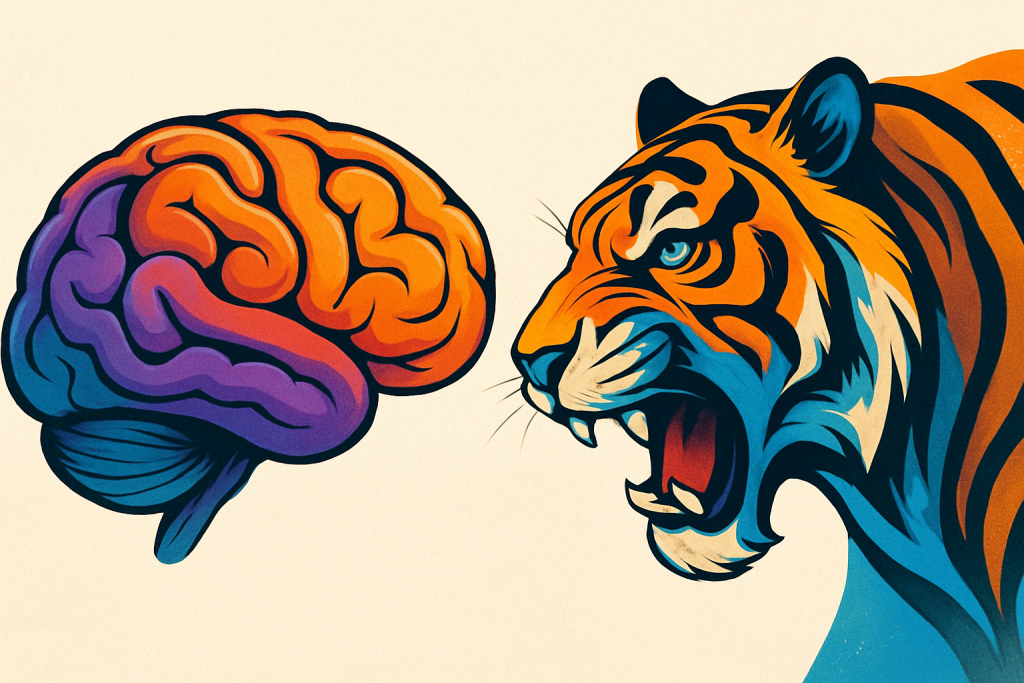
Welcome to our lesson on the limbic brain! In this lesson, we’ll explore one of the most fascinating and powerful components of the human brain—often called the survival brain. The limbic system plays a key role in fast, instinctive responses that helped our ancestors survive—and still shape how we react today.
Why This Matters:
The limbic system is immensely fast and emphasizes immediate safety, but sometimes at the cost of thoughtful, reflective decision making. By recognizing the patterns of the limbic brain, we can begin to redirect our responses and leverage the mindfulness of our prefrontal cortex, paving the way for constructive, empathetic, and resourceful thinking in our daily lives.
? Introduction & Learning Goals
In this chapter, we’ll take a deep dive into the limbic brain—its speed, its purpose, and how it affects your behavior.
You’ll explore:
- Why the Limbic Brain Is So Fast: Understand the evolutionary roots of its lightning-quick reactions.
- How It Keeps You Safe: See how it constantly scans for danger and mobilizes your body’s resources to respond.
- Rapid Action, Minimal Data: Understand how the limbic brain makes quick decisions without much information, and what this means for you.
- Binary Thinking: Learn why the limbic brain tends to label things as “good” or “bad,” and how that affects your perception.
- Fear Hormones in Action: Explore how adrenaline and cortisol power quick decisions—and their downsides.
- Other Names for the Limbic System: Discover why it’s also known as the reptilian brain or the lower-order brain.
- Putting It into Practice: Learn to recognize limbic patterns in real time and gently shift toward more conscious, resourceful thinking.
By the end of this lesson, you’ll know how to recognize when your limbic brain is in charge—and how to redirect your attention to your more thoughtful, reflective self when it matters most.
Topics in this Lesson
Introduction to the Limbic Brain
Lesson 3 introduced you to the three part model of the brain. The parts of the thinking brain that first developed are what we call the survival brain, reptilian brain, lower order brain, or limbic system, consisting of heuristics, which are the parts that quickly propose possible actions to a situation and the emotional parts that assess danger and decide on a particular action. These parts of the brain started developing in the first multicellular animals capable of movement, around 500 million years ago.
The limbic system:
- Activates in as little as 2/100 of a second and is primed to detect threats.
- Fuels decisions in under a second, often relying on rapid, binary judgments (good/bad, safe/danger).
- Releases adrenaline and cortisol to quickly focus the body and mind on one path to safety.
Primed for Danger
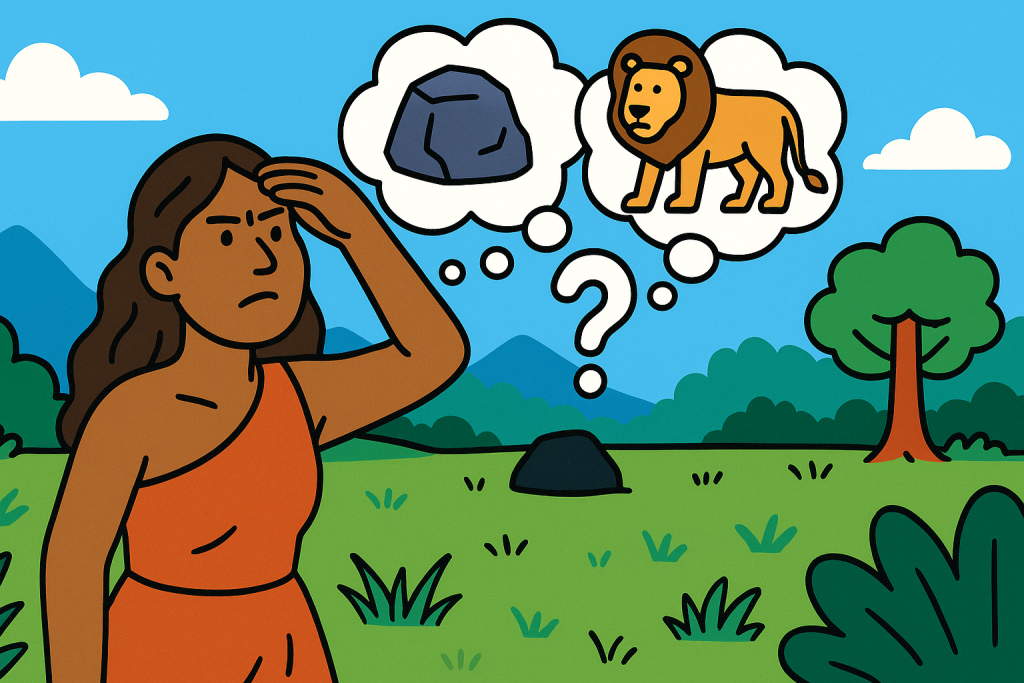
Imagine living thousands of years ago and you look up and detect some object a few yards or meters away.
That object may be just a rock that isn’t moving.
The object might be a sleeping lion.
The object might be a wolf running directly at you.
That object might be something to eat.
You have less than a half second to assess the situation and decide what to do. A mistake, and you could be dinner.
The limbic system evolved to protect us and its number one priority is speed.
In evolutionary terms, reacting instantly to a threat often meant the difference between life and death. If a rustle in the bushes might be a predator, there’s no time to ponder probabilities. Your brain has to act now.
That’s why the limbic brain doesn’t ask:
“Is this slightly dangerous or extremely dangerous?”
It simply says:
“Threat detected. React now.”
This fast, protective mechanism was critical in environments full of predators, sudden weather shifts, or tribal conflicts. And today, it still kicks in—even when the “danger” is emotional or social.
Why Fast Isn’t Always Smart
Quick reactions are helpful sometimes—like slamming the brakes in traffic, or stepping away from a falling object.
But in modern life, many limbic reactions misfire. They treat minor discomfort or misunderstanding as a major threat:
You see a donut, and your brain screams, “Eat it now!” (habit reaction)
You get a vague message from your boss, and you lash out in frustration—only to later realize it wasn’t meant critically. (fight reaction)
The problem? These reactions happen before your logical brain (the prefrontal cortex) has a chance to step in and say,
“Wait… is this really the best move?”
The Five Fast Paths: Limbic Survival Modes
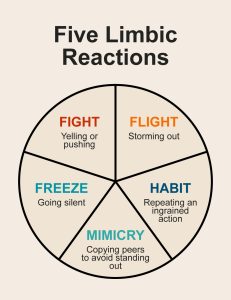
Your limbic system uses five main types of responses:
- Fight: Confront the threat (e.g., snapping back at someone)
- Flight: Escape or avoid (e.g., procrastinating on a hard task)
- Freeze: Shut down or go blank (e.g., mind going blank in a meeting)
- Habit: Rely on automatic routines (e.g., grabbing your phone when anxious)
- Mimicry: Copy others’ behavior (e.g., laughing at a joke you didn’t understand, just to fit in)
These aren’t “good or bad”—they’re automatic. MindShifting means recognizing when we are making an automatic reaction, evaluating whether or not it’s helpful, and then learning to be more resourceful when they are not.
For example, when one is tempted to act in flight, flight, freeze, habit, or mimicry mode, one could ask the question:
“Is this reaction helpful right now, or just automatic?”
Why This Matters
Understanding the speed and simplicity of the limbic system helps you recognize when you’re in a reactive mode.
That awareness is the first step in MindShifting—pausing just long enough to give your PFC a chance to re-engage and guide you toward a more resourceful response.
Evolutionary Purpose
The limbic system evolved to meet three priorities. We have spent time on the first, keeping the organism safe from danger, which means reacting fast, with little information, and focusing the organism on completing that action.
A second purpose is fitting in with a group. The limbic brain observes what others in the group are doing, and will often default to doing the same things
We humans live in multiple groups: families, extended families, communities, religions, workplaces, nations, and so on. Groups aren’t just a human phenomenon, there are groups throughout the animal kingdom. Bees, fish, and ants all form groups. Most mammals form groups.
The advantages of the need to fit in with groups starts with defense. A group can preserve individual members so that the species can reproduce. The antelope isolated from its herd is the one eaten by the lion.
Second, it’s through groups that a species passes on procedures and techniques. It’s very efficient for animals to learn from others rather than having to experience everything and learn from mistakes..
Third, there is power in a group. Our human ability to mobilize groups has created civilizations, goods and services, buildings, cities, and towns, and science and technologies.
A third priority of the limbic parts of the brain is to conserve energy, to reduce the work of thinking. A snap decision takes less time, effort, and uses less energy than using critical and creative thinking to figure out what to do.
Role of Adrenaline and Cortisol
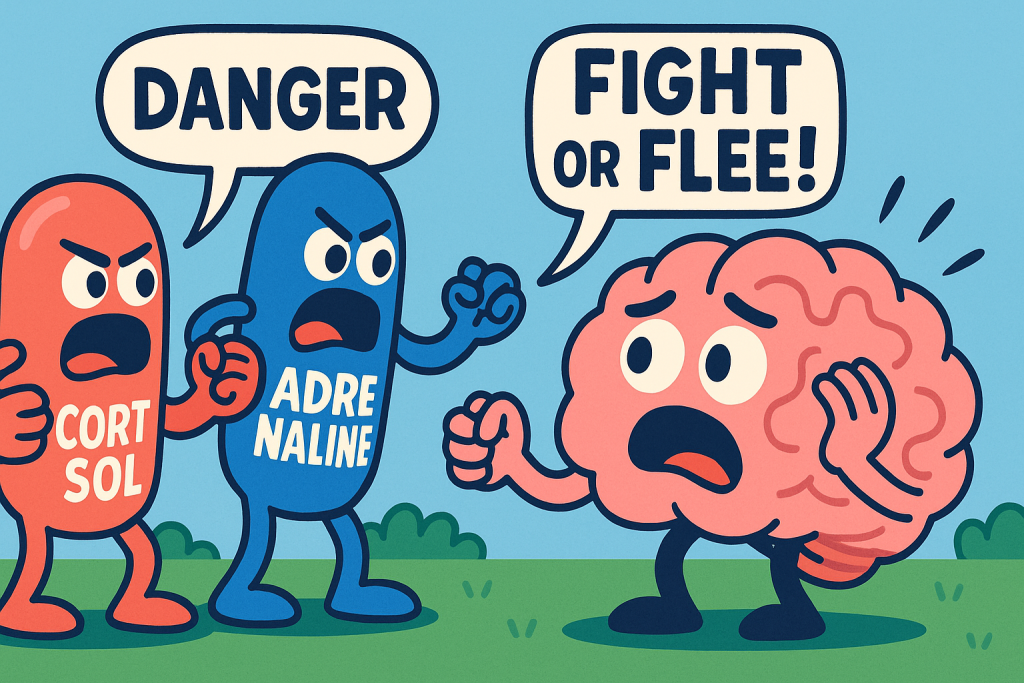
Many marathon runners describe hitting “the wall” where their body feels completely depleted. Sometimes, a rush of adrenaline and cortisol, the two stress hormones help mobilize energy reserves and the mental and physical push to finish.
In 1982, Angela Cavallo was watching her teenage son, Tony, working on the suspension of his 3,700 pound (1,700 kg) 1964 Chevrolet Impala when the jacks collapsed, the car fell, and Tony was unconscious and pinned underneath. Somehow, under what is attributed as a release of stress hormones, Angela was able to lift the car and free her son.
Adrenaline and Cortisol:
- Increase alertness to danger
- Augment the strength of muscles and senses, and
- Reduce distractions by shutting down the higher level functions of the prefrontal cortex.
In times of life and death danger, this is positive, resulting in heightened awareness, an immediate energy boost, faster reflexes, and improved focus
In our modern society, where the limbic systems evaluates non-dangerous situations as threats this means we react with tunnel vision, we are quick to judge, we can’t align our actions to long term values or goals, and we react in fight or flight mode to mild stressors, such as a social media post or email that annoys us.
Why It’s Important
Our limbic brains, and the limbic brains of everyone we interact with, interpret a harsh email as a threat, just as it would a charging wild animal. A threat is a threat, and threats trigger the release of a surge of fear hormones.
That’s why we, and all other members of the human race, overreact to minor frustrations; our limbic system cannot readily gauge severity.
Can’t Distinguish Degrees of Threat
- To the limbic brain, a harsh email can feel as threatening as a wild animal: it triggers a surge of fear hormones.
- This is often why we overreact to minor frustrations—our limbic system cannot readily gauge severity.
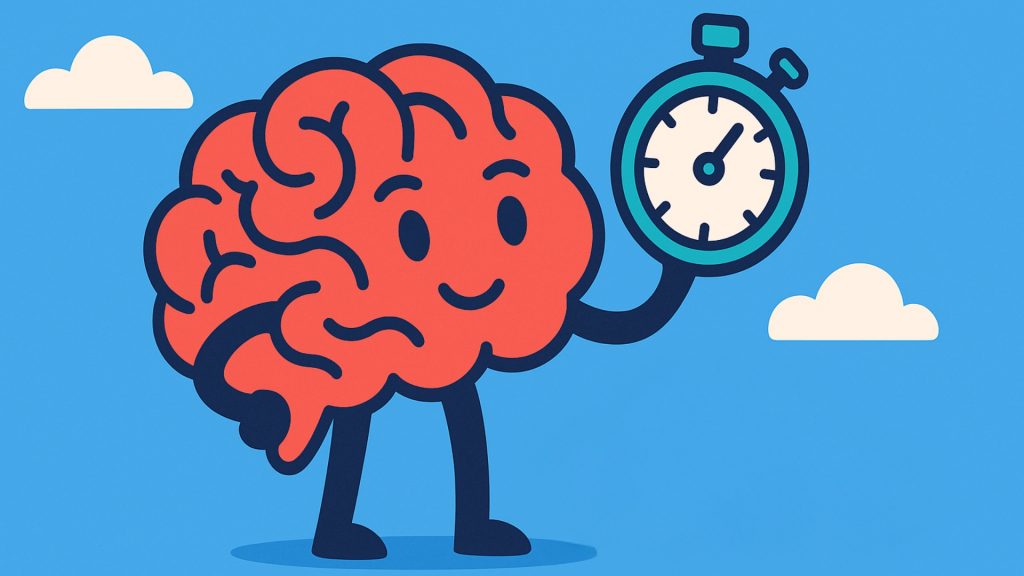
Under a Second: The Speed of Limbic Reactions
The limbic system is designed to react before you even know what’s happening. In many cases, your brain has already made a decision—or launched an emotional response—within a fraction of a second.
Only afterward might your prefrontal cortex (PFC)—your slower, more thoughtful brain—kick in to justify the reaction or build a story around it.
This is why we often feel like we’ve “rationally decided” something, when in fact, our emotional brain decided first—and our rational brain is just catching up.
Why So Fast? Why So Little Data?
In ancestral environments, you didn’t need to analyze every detail to decide whether to run. If a shadow looked like a predator, it was smarter to assume the worst and react—even if you were wrong nine times out of ten.
Fast, imperfect decisions kept us alive. Slow, careful analysis could get us killed.
So the limbic system evolved to:
- Make snap decisions with incomplete information
- Prioritize speed over accuracy
- Default to negativity and threat detection
This is often referred to as a negativity bias—your brain’s built-in filter that asks:
“What’s wrong here?” before it asks “What’s going well?”
When Speed Becomes Sabotage
This bias is still helpful in real danger (e.g., hearing a crash, noticing smoke, crossing a busy street).
But in modern life—where threats are often social or emotional—this fast system can backfire.
Why?
Because when the limbic system reacts first:
- Your PFC often shuts down, especially if fear hormones are high.
- You’re more likely to go into fight, flight, freeze, or other default patterns.
- You lose access to your creative, logical, and empathetic thinking.
So your brain might:
- Misinterpret a coworker’s feedback as an attack.
- Assume an ambiguous message means something negative.
- Snap, avoid, shut down, or overreact—before checking the facts.
This is why we say the limbic system can “sabotage” you—it’s not malicious, just outdated in some of today’s contexts.
What MindShifting Teaches You
MindShifting helps you spot these fast responses—not to get rid of them, but to question whether they’re serving you in that moment.
With practice, you can:
- Notice when your brain is in “auto-pilot threat mode”
- Pause before reacting
- Re-engage your PFC to consider better options
That’s the moment where transformation happens—when reaction turns into reflection.
? Interactive Exercise
There are five questions on the exercise below. Read each scenario carefully. Based on the behavior described, choose which response it reflects: Fight, Flight, Freeze, or Mimicry.
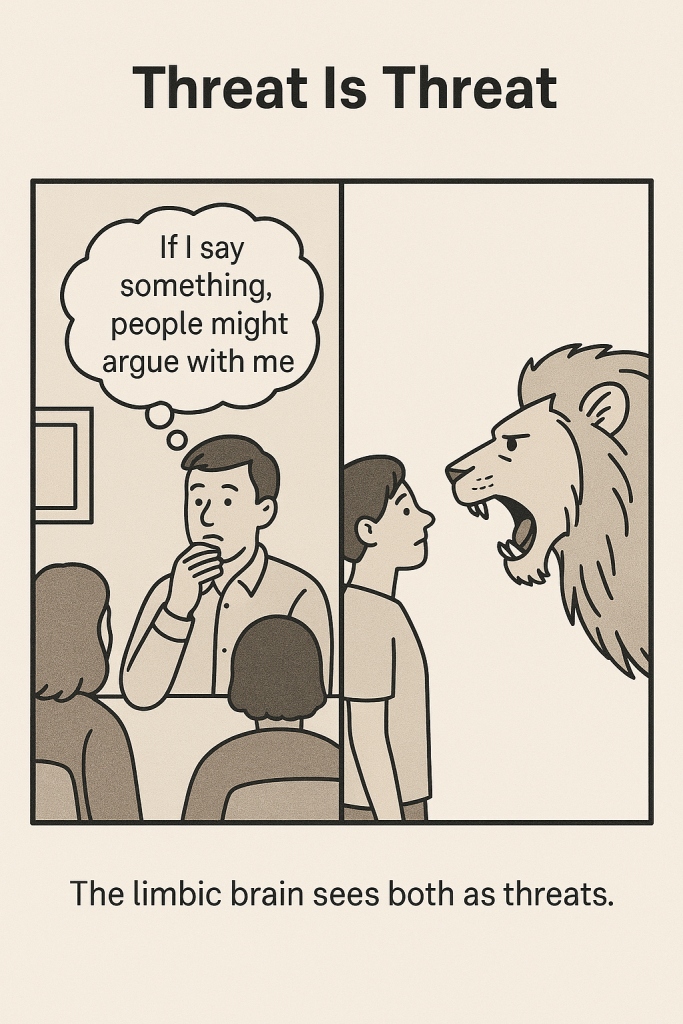
A Threat Is a Threat
- Once triggered, the limbic system sees no difference between “mild risk” vs. “serious threat.”
- This can lead to exaggerated emotional responses or snap judgments.
- The emotional brain doesn’t scale threat levels—it may react to social judgment the same way it would to a wild animal.
Examples in Everyday Life
Being Put on the Spot: When someone asks you a tough question unexpectedly in a meeting, it might prompt the same hormones as facing a real predator.
- Social Fear: Worrying about a party can feel physically threatening, causing sweaty palms or racing heart.
After our senses detect a situation, in less than a second, our limbic system pulls a possible action from the five types of limbic responses: fight, flight, freeze, habit, or mimicry. When that action is challenged, the survival brain treats that challenge as a threat and releases the stress hormones.
While that reaction may have served our ancestors when they were in true survival mode, they aren’t always effective in modern life.
When triggered by everyday challenges—like difficult conversations or performance pressure—these responses can actually escalate stress rather than help you navigate it. The key is to recognize these automatic patterns and remind ourselves that we have other options—especially once the prefrontal cortex is engaged.
MindShift Insight
In the past, these reactions kept us safe. But in today’s world, many of the “threats” we face aren’t life threatening and require more nuanced responses than fighting, running away, or freezing. We need new tools—like reflection, empathy, and creative thinking—to deal with them effectively.
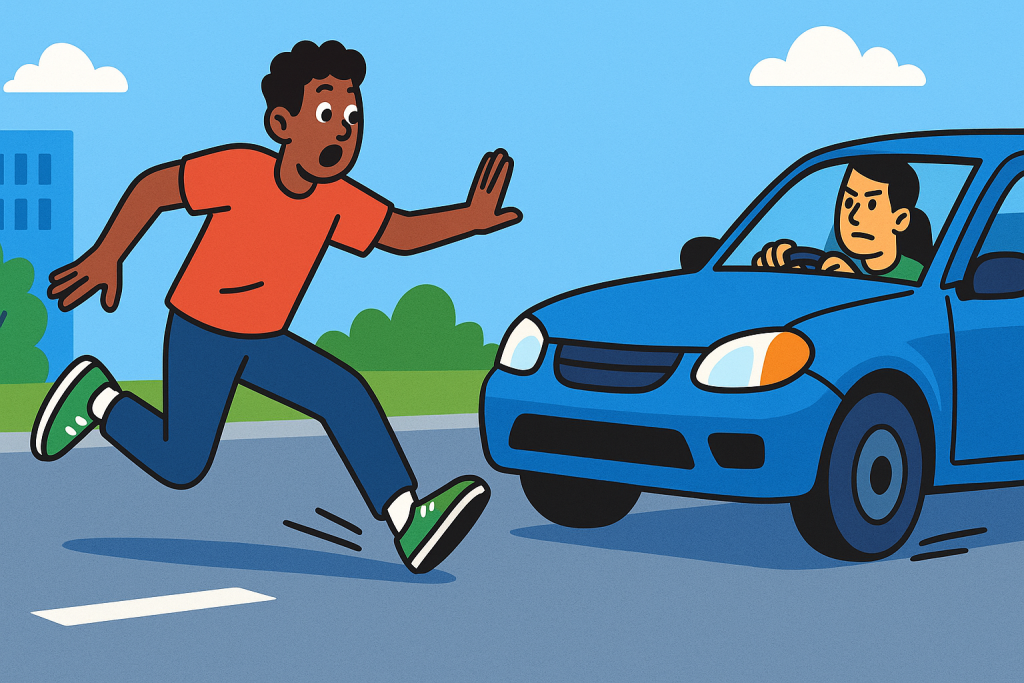
When your brain perceives a threat, it quickly floods your body with adrenaline and cortisol—two powerful stress hormones.
- Adrenaline prepares you for immediate action: your heart races, your muscles tense, and your focus sharpens.
- Cortisol helps sustain that readiness, mobilizing energy by increasing glucose in your bloodstream.
These chemicals were critical for survival in dangerous environments. They gave our ancestors the boost they needed to fight, flee, or freeze effectively. But while these hormones are helpful in short bursts, they can become harmful when activated too often, for long periods of time, or in situations that don’t truly require them.
Positive
- Quick surge of focus and energy to address immediate problems.
- Potential to save you from real harm (dodging a car, reacting to a fire).
Negative
- Hold us back from problem-solving and creative thinking.
- Once we lock into a limbic reaction we do not look for better alternatives.
- We miss other opportunities.
- Long term exposure to higher levels of stress hormones harm our mental and physical health.
- Limbic reactions inhibit out ability to collaborate and tend to harm long term relationships.
? Exercise 2: Internal Reactions – Helpful or Hijacked?
Objective:
Recognize the internal thought patterns that signal either:
- A resourceful, reflective mindset (Prefrontal Cortex engaged)
- A limbic override (reactive, emotional, habitual, or avoidant)
Instructions:
You’ll read the internal thoughts of 10 individuals. Decide if each reaction is:
- ✅ Likely PFC Engaged (Resourceful & Reflective)
- ⚠️ Likely PFC Offline (Limbic Override)
Check the Feedback Below
Check feedback
- “This test is brutal. I’m not sure I’m ready—but I’ll start with what I do know. If I freeze up, I’ll pause and breathe.” –> ✅ Likely PFC Engaged (Resourceful & Reflective)
- Maya is planning ahead, staying calm under pressure, and using strategies to stay grounded.
- Trevor avoids his teammates revising their project. He tells himself, “They’ll just change it again. No point in saying anything.” –> ⚠️ Likely PFC Offline (Limbic Override)
- Trevor is disengaging without asserting himself, using internal stories to rationalize inaction—a freeze response masked by justification.
- “My manager always picks on me. I’m just doing my job. I need to be ready to defend myself before they twist things again.” –> ⚠️ Likely PFC Offline (Limbic Override)
- Jenna is anticipating attack and priming to defend, without exploring communication or perspective-taking.
- “They didn’t include me again. Whatever. I’ll just stop contributing from now on.” –> ⚠️ Likely PFC Offline (Limbic Override)
- Omar is withdrawing from engagement, likely from emotional hurt, without reflection or resolution—classic avoidance.
- Ava receives a poor review and thinks: “My manager clearly doesn’t like me. I’ll just avoid them from now on.” –> ⚠️ Likely PFC Offline (Limbic Override)
- Ava internalizes the review as personal rejection and withdraws, rather than seeking clarity or growth. This is a defensive flight reaction.
- “That feedback stung. But I’ll reread it tomorrow with fresh eyes and see if I can improve.” –> ✅ Likely PFC Engaged (Resourceful & Reflective)
- Malik is processing emotion but choosing a growth-oriented response—PFC engaged.
- “I’m overwhelmed. I’ll ignore everything for now and deal with it later.” –> ⚠️ Likely PFC Offline (Limbic Override)
- Deena is mentally checked out. Rather than regulating stress, she’s escaping it—a freeze or habit response under stress.
- “What would I tell a friend in this situation? Maybe I should try that myself.” –> ✅ Likely PFC Engaged (Resourceful & Reflective)
- Nolan uses self-distancing and metacognition—hallmarks of PFC engagement and emotional maturity.
- “I want to eat this dessert. It’s not that many calories, and I can get back on my diet tomorrow.” –> ⚠️ Likely PFC Offline (Limbic Override)
- Sandra may be following a habit and creating rationalizations. The decision feels justified, but it’s likely driven by impulse and emotion, not long-term goals.
- “I always procrastinate, but I work better under pressure anyway.” –> ⚠️ Likely PFC Offline (Limbic Override)
- Leo is likely repeating a pattern that feels familiar, not intentional. The reasoning is post-hoc justification for avoidance—a classic heuristic + emotional override.
Congratulations! You’ve now explored the limbic system—the brain’s rapid-response network that kicks in when things feel uncertain or unsafe. You’ve seen how it moves fast, bypasses deep thinking, and responds in five main ways:
| Limbic Reaction | Quick Example |
|---|---|
| Fight | Snapping back during a disagreement |
| Flight | Avoiding an email or walking away from tension |
| Freeze | Going blank during a meeting or decision |
| Habit | Saying “yes” automatically even when overloaded |
| Mimicry | Following a crowd even when it feels off |
These responses are not “bad”—they’re protective shortcuts. But when they take over situations that call for deeper thought, creativity, or empathy, we can get stuck or misfire.
? Key Takeaways:
The limbic brain is your fast, protective ally. MindShifting doesn’t mean silencing it—it means knowing when it’s speaking, and choosing whether to listen, question, or hand the reins back to your prefrontal cortex.
Next Steps in MindShifting
In Lesson 5, we’ll explore the Prefrontal Cortex, how it operates when we are in limbic mode versus what happens when we tap into its powers and we are able to access our own resourcefulness, critical and creative thinking, and our capacity for empathy.