
2. Understanding Your Brain’s Default mode
Live
Your brain is designed to keep you safe. When something unexpected or uncertain happens, it doesn’t ask for permission, it reacts.
In this lesson, we’ll revisit those default settings. You’ll recap how fast reactions form, how your brain builds stories to justify them, and how those patterns can become invisible traps that limit your thinking. Once you recognize what’s happening beneath the surface, you can start to change it, and open the door to your most resourceful self.
Why It Matters
Reviewing how your brain’s default mode works is worthwhile because it explains why you sometimes react automatically or feel caught in familiar emotional loops. These patterns are survival responses shaped by past experiences. By recognizing when your brain is running on autopilot, you open the door to interrupting unhelpful cycles and engaging the more thoughtful, creative parts of your mind.
? Introduction & Learning Goals
In this lesson, you will review:
- How your brain uses fast, automatic reactions to respond to perceived threats
- How stories are constructed after the fact to justify those reactions, even when they limit you
- How certainty, judgment, and blame can signal that you’re stuck in a reactive pattern
- Tools for self-awareness and metacognition that help you step out of that pattern
- The benefits of Sage mode and preview the five powers you’ll explore in the lessons ahead
Topics in this Lesson

This topic is a review refresher on limbic reactions, in case there are aspects that you want to refresh before diving deeper.
Imagine someone tosses a soft ball toward you unexpectedly. Before your brain can register what’s happening, your hand jerks up to block it, or your body flinches. You didn’t plan that reaction. It just happened.
That’s your limbic brain in action: that’s a habitual response, something you are fluent in, you can do without thinking, and you can do fast.
This part of your brain evolved to keep you alive. It doesn’t analyze. It reacts. And it does so in milliseconds, far faster than your reflective, thoughtful mind can process. Whether the situation is physical (like a loud noise) or emotional (like a colleague’s sharp tone), your limbic system treats it like a potential threat and responds instantly.
These quick reactions are about safety. And while they were life-saving for our ancestors, in modern life they can sometimes get in the way.
The Five Limbic Action Types
The following is a review of limbic reactions. As we have learned in previous modules, the brain’s default responses fall into five main categories. Each one is a type of “script”, a well-worn pattern your brain follows when it senses something important or unsettling.
- Freeze
You stop, mentally or physically. This can give you a moment to assess, or it can leave you paralyzed when action is needed. - Fight
You push back, through irritation, defensiveness, or control. This can feel like taking charge, but it’s often fueled by fear. - Flight
You try to escape discomfort. Maybe you leave the room, change the topic, or mentally check out. - Habit (Fluency)
You fall into a routine without thinking. These are the “autopilot” moments, reliable, efficient, but not always helpful. - Mimicry
You copy others to blend in or feel safe. This can help you connect, or make you ignore your own values or instincts.
Each of these patterns is useful in the right context. But when they become automatic and unexamined, they can limit your ability to respond with clarity, intention, and creativity.
Efficiency Has a Cost
As we discussed, the limbic system’s speed comes at a price: it doesn’t know the difference between a real threat and a perceived one. That means your brain might react strongly to things that aren’t actually dangerous, like critical feedback, a late reply, or a frown in a meeting.
When this happens, you’re not making choices. You’re running a script.
? Interactive Exercise: Spot the Limbic Reaction
Instructions: Because this topic is a review, there will only be three questions in this exercise. Read each question carefully. The questions are based on the description of the limbic system, its functions, and the five limbic action types. Choose the option that best answers the question according to the information provided in the text.
? Key Takeaways
- Your brain has a built-in system for fast reactions called the limbic system.
- These reactions, freeze, fight, flight, habit, and mimicry, are designed for survival, not reflection.
- While efficient, they often bypass your deeper reasoning and creativity.
- Recognizing these patterns is the first step toward shifting from automatic reaction to thoughtful response.

Have you ever snapped at someone, then later thought, “Well, they were being rude anyway”? Or avoided a task and told yourself, “I probably wouldn’t have done it well, so it’s just as well I waited.”
That’s your brain at work, to defend the decision it already made.
After we react quickly, often through a limbic script like irritation, avoidance, or shutting down, our brain builds a story to explain what just happened. The story makes the action feel justified, even when it wasn’t the best response. It helps us feel consistent and in control. But in doing so, it can trap us in limited thinking.
The Brain’s Need to Be “Right”
Your mind wants things to make sense. It’s uncomfortable to think, “Maybe I overreacted,” or “Maybe I avoided that because I was afraid.” So it fills in the blanks with a story, one that supports the action you already took.
These post-reaction stories often sound like:
- “They deserved it.”
- “I had no choice.”
- “That’s just how I am.”
They protect your ego, but they also keep you stuck. Instead of considering new options or learning from the moment, the story seals the reaction as “reasonable,” even if it costs you clarity, connection, or progress.
Stories that Sound true, But Limit You
Not all stories are obviously self-protective. They often sound rational, even wise. But listen more closely, and you may hear the deeper function: they stop you from having to reconsider your actions.
For example:
- “If I had spoken up, it would have made things worse.”
- “Everyone already knew what I was going to say.”
- “They probably wouldn’t have listened anyway.”
These are subtle justifications. They’re stories. They close doors that might otherwise have stayed open.
The Real Cost of Justifying
When we tell ourselves stories to justify our actions, we stop being curious. We stop asking, “What else could have been possible?” That means we lose the chance to grow, to understand, or to respond differently next time.
And because the story feels like the truth, we may repeat the same pattern again, reinforcing the same script and never realizing we had a choice.
? Interactive Exercise: What’s the Story You’re Telling?
Instructions: Read each question carefully. The questions explore how the brain creates stories to justify actions after quick reactions. Consider how these justifying stories can feel true while limiting growth or connection. Choose the option that best reflects the idea presented in the text. Each question has only one correct answer.
? Key Takeaways
- After fast reactions, your brain often builds stories to justify what happened.
- These stories make you feel consistent, but can block insight, growth, and connection.
- The more often a story is repeated, the more true it feels, regardless of its usefulness.
- Becoming aware of justifying stories allows you to reopen possibilities and consider better options.
As you’ve seen in earlier modules: the moment we feel absolutely certain, we’re probably not thinking clearly.
You have explored how the brain creates scripts, automatic behaviors, and stories that explain or justify those behaviors. You saw how these patterns help us move through life efficiently, but also how they can keep us locked into limited ways of responding.
Now, we return to that idea through a sharper lens: what happens when those patterns become rigid? When your brain insists it already knows what’s right, what’s true, or what must happen next?
That’s when you’re most likely stuck, and least able to access your resourceful, Sage mind.
The False Comfort of Certainty
When you’re in a reactive mode, your brain wants to feel secure. So it offers you certainty.
- “I know what they meant.”
- “I’m sure this won’t work.”
- “There’s only one right way.”
- “I’m not good enough.” or “I’m not worthy.”
- “They hate me.”
This certainty feels strong, but it narrows your thinking. It shuts down curiosity. And most importantly, it signals that your limbic system is in control, not your reflective mind.
How the Five Limbic Reactions Can Get Stuck
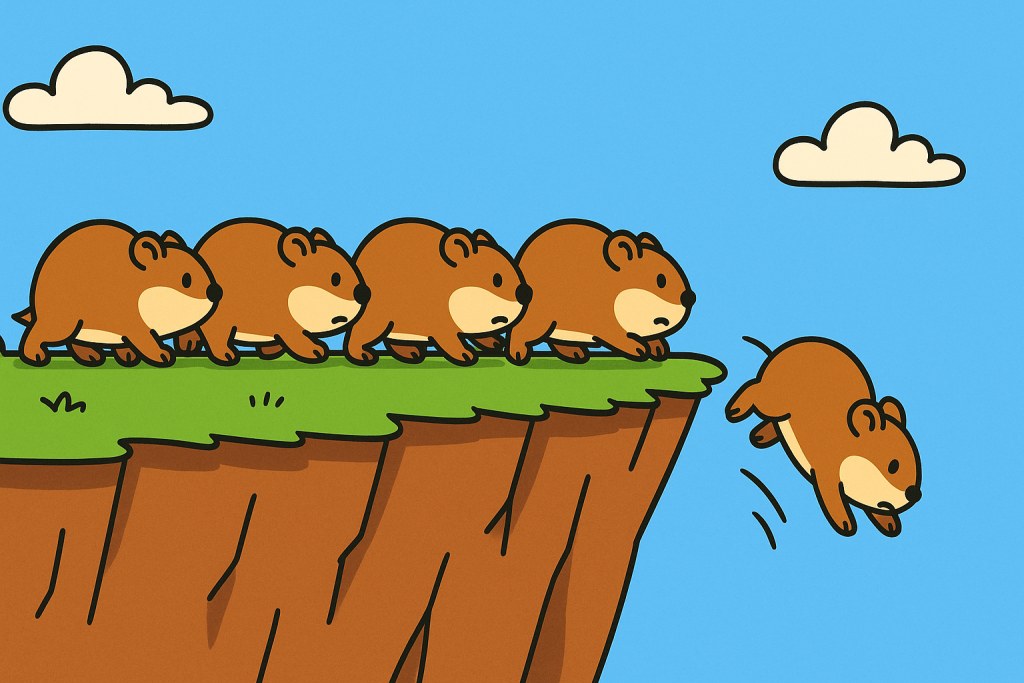
Let’s revisit the five fast reaction types, and see what it looks like when certainty takes over.
- Freeze
“There’s no way out of this.”
You feel paralyzed. Your brain insists that doing nothing is the safest, or only, option. - Fight
“I have to defend myself.”
You feel attacked, even if the situation doesn’t warrant it. Your mind locks into proving a point, instead of seeking understanding. - Flight
“I can’t deal with this.”
You avoid a person, task, or truth, not because it’s impossible, but because it feels overwhelming. - Habit (Fluency)
“This is just how I do things.”
You follow the familiar path, even when it no longer serves you. The brain clings to routine and resists change. - Mimicry
“Everyone else seems to think this way, so I should too.”
You defer to others, assuming their way is best, even when it goes against your values or instincts.
Judgment, Blame, and the Need to Be Right
When we’re stuck, it’s not just because we reacted quickly. It’s because our brain explains and defends that reaction afterward.
That often shows up as:
- Judgment: “They’re wrong. I’m right.”
- Blame: “It’s their fault.” Or “It’s all my fault.” Or “It’s the situation; nothing would have worked.”
- Righteousness: “There’s nothing to reconsider, I know what’s happening here.”
These mental habits reinforce the reactive loop. The more we explain, the more fixed our perspective becomes. And the harder it is to step outside that frame and think differently.
From Repetition to Recognition
What’s missing from those three reactions above is humility. Humility is being open that you don’t have all the answers, that there might be a better way, that you might even be wrong. Humility is actually the only way to learn and improve. Humility is a Sage attribute.
You’ve practiced this before: noticing the script, catching the story, and asking if it still serves you.
This lesson invites you to do it again, with a specific focus on moments when you feel absolutely sure. That’s your signal. Not to double down, but to pause.
Because when you loosen your grip on certainty, even just a little, something powerful happens: your Sage mind has room to re-enter.
? Key Takeaways
- This is a review and deepening of patterns you’ve explored in earlier modules, especially how fast brain reactions become rigid.
- Feeling “sure” is often a sign that your reactive brain is stuck in a fixed pattern.
- All five limbic reactions can become traps when certainty takes over.
- Judgment, blame, and righteousness keep you locked in your default mode.
- The moment you notice certainty, you have a choice: pause, question, and create space for Sage thinking.

By now, you’ve already explored what it means to notice the patterns of your limbic reactions. You’ve practiced observing your own reactions and thoughts without judgment. You’ve started building the habit of pausing when something feels familiar, but unhelpful.
This topic is a moment to pause and reconnect with the tools you already have. Because in the moments when you feel stuck, you don’t need something new, you need something you already know how to do.
What Is Self-Awareness?
Self-awareness is the ability to recognize what you’re feeling, doing, or thinking while it’s happening, not just afterward. Self-awareness and metacognition require a degree of humility, because if you are not questioning yourself, you are not really being self-aware.
It might show up as:
- Noticing that you’re avoiding something
- Catching yourself making assumptions
- Realizing you’re reacting more strongly than the moment calls for
You practiced this through reflection prompts, mentor conversations, and interactive exercises. The skill is simple, but powerful: observe yourself, without immediately trying to fix or justify.
That moment of observation is the first break in the script.
What Is Metacognition?
Metacognition means thinking about how you think. It’s the second layer of awareness, asking yourself:
- Am I reacting or responding?
- What story am I telling myself right now?
- Is this thought helping me move forward, or keeping me stuck?
These questions bring your prefrontal cortex back online. They create space. And in that space, your Sage self becomes available again.
Recognizing the Signs of Being Stuck
You explored what it feels like to be caught in a loop, when certainty takes over, or when you find yourself repeating the same pattern again and again.
Self-awareness and metacognition help you catch those moments in real time. Some signs you’ve seen before:
- You feel sure you’re right (or that someone else is wrong)
- You notice judgment or blame in your thoughts
- You’re explaining your reaction instead of questioning it
- You’re repeating something familiar, even though it’s not helpful
? Interactive Exercise: Metacognition in the Moment
Instructions: Read each question carefully. The questions focus on self-awareness, metacognition, and recognizing when you are stuck in unhelpful patterns. Reflect on the definitions and examples provided in the text. Choose the option that best represents the idea being described. Each question has only one correct answer.
? Key Takeaways
- Self-awareness is your ability to observe what’s happening in the moment.
- Metacognition is your ability to examine how you’re thinking, and whether that’s helping or hindering you.
- These skills are not new, they’re ones you’ve already practiced throughout the course.
- Recognizing signs of being stuck is the first step toward shifting your mindset.
- You already have the tools. This is your chance to keep using them, more consciously, more often.
You’ve already met the concept of Sage Mode in Module 4. You explored what it feels like, how it differs from survival mode, and how it allows you to think, connect, and act from a deeper place.
This topic is a reminder of why Sage Mode matters, and a preview of how we’ll go deeper.
If the earlier modules helped you recognize when you’re stuck, this module helps you strengthen the mindset that gets you unstuck.
What It Feels like to Be in Sage Mode
Think back to a time when you felt fully engaged, not anxious, not distracted, but calm, present, and focused. You were curious rather than judgmental. Open rather than defensive. Grounded in yourself, but still connected to others.
That’s Sage Mode.
In this state, your brain works differently. You access:
- Focus without strain
- Creativity without chaos
- Confidence without ego
- Empathy without losing yourself
It’s not a perfect or permanent state, but it’s one you can return to, more and more often, through practice and awareness.
What Sage Mode Makes Possible
When you’re in Sage Mode, you’re more:
- Resilient in the face of challenge
- Effective in communication and decision-making
- Flexible when plans change
- Curious instead of reactive
- Grounded instead of overwhelmed
You’re approaching problems from a mindset that’s capable of solving them.
The Five Powers of Sage Mode

Sage Mode is not just a feeling, it’s a set of capabilities that you can develop. Shirzad Chamina calls these the Five Powers:
- Empathy – The ability to connect with others and with yourself in a caring, grounded way
- Exploration – The mindset of curiosity and openness, even when you don’t have the answers
- Innovation – The creative power to build something better from what is
- Navigation – The internal compass that helps you align actions with values
- Focused Action – The ability to move forward with persistence and joy
Each of these powers helps you shift out of reactivity and into meaningful engagement. And just like a muscle, each one can be strengthened through conscious use.
What’s Coming Next
The rest of this module is dedicated to exploring these five powers in depth. You’ll see how they apply to real life, how they interact, and how you can bring them online when you need them most.
You already have a Sage mind. Now it’s time to unleash it fully.
? Key Takeaways
- Sage Mode is a state of flow, presence, and inner clarity, it makes you more resilient, focused, and grounded.
- You’ve already encountered Sage Mode in earlier lessons; now you’ll explore it more deeply.
- The Five Powers of Sage Mode are: Empathy, Exploration, Innovation, Navigation, and Focused Action.
- Each of these can be practiced, developed, and used to respond to life with wisdom and creativity.
This lesson has brought together key ideas you’ve already encountered throughout the course: how your brain reacts automatically, how it builds stories to justify those reactions, and how certainty and blame can trap you in reactive patterns. You also revisited the practices of self-awareness and metacognition, your core tools for shifting out of stuckness and back into clarity.
Though these concepts aren’t new, they’re worth revisiting. They form the mental foundation that allows the Sage powers to emerge and grow.
? Key Takeaways
- Your brain’s default responses are fast and familiar, but not always helpful.
- Certainty, judgment, and blame often signal that you’re stuck in a reactive loop.
- Self-awareness and metacognition are skills you’ve already begun to build; now is the time to strengthen them.
- Shifting into Sage mode requires noticing when you’re stuck and gently choosing another path.
Next Steps in MindShifting
In the next lesson, you’ll begin a deep exploration of the Five Powers of Sage Mode, starting with Empathy. You’ll learn how empathy helps you connect, with others and yourself, and how it offers a meaningful alternative to judgment or blame, even in difficult moments.
You’ll also explore how empathy works in everyday life: in success, in challenge, and in moments when your inner critic tries to take the lead. This is where Sage Mode becomes practical, grounded, and deeply human.